Detailed Guide to How GFCI and AFCI Outlets Protect Your Family
By B&M Electric June 1, 2026
Why Understanding How GFCI and AFCI Outlets Protect Your Family Could Save a Life
How GFCI and AFCI outlets protect your family comes down to two distinct but equally critical jobs: one stops electrical shock, and the other stops electrical fires — and your home needs both.
Here is a quick breakdown:
| Protection Type | What It Guards Against | Where It’s Needed |
|---|---|---|
| GFCI (Ground Fault Circuit Interrupter) | Electrical shock from ground faults | Bathrooms, kitchens, garages, outdoors, laundry rooms |
| AFCI (Arc Fault Circuit Interrupter) | Electrical fires from dangerous arcing | Bedrooms, living rooms, hallways, kitchens, home offices |
| Dual-Function GFCI/AFCI | Both shock and fire hazards | Areas requiring both protections (e.g., kitchens, laundry) |
Most homeowners know to look for smoke detectors and fire extinguishers. But two of the most important safety devices in your home are quietly built right into your walls — and many households in Torrance and across the South Bay are missing them entirely.
Electrical failures are the second leading cause of home fires in the U.S., accounting for an estimated 24,000 fires every year. Arc faults alone are responsible for more than 35,000 home fires annually. Meanwhile, ground faults — the hazard GFCIs are designed to catch — are involved in a significant share of electrocution deaths each year. The good news: GFCI protection is estimated to prevent around 70% of those deaths, and AFCIs could stop more than half of all electrical fires before they start.
This guide walks you through exactly how these devices work, where they belong in your home, and how to make sure your family is fully protected.
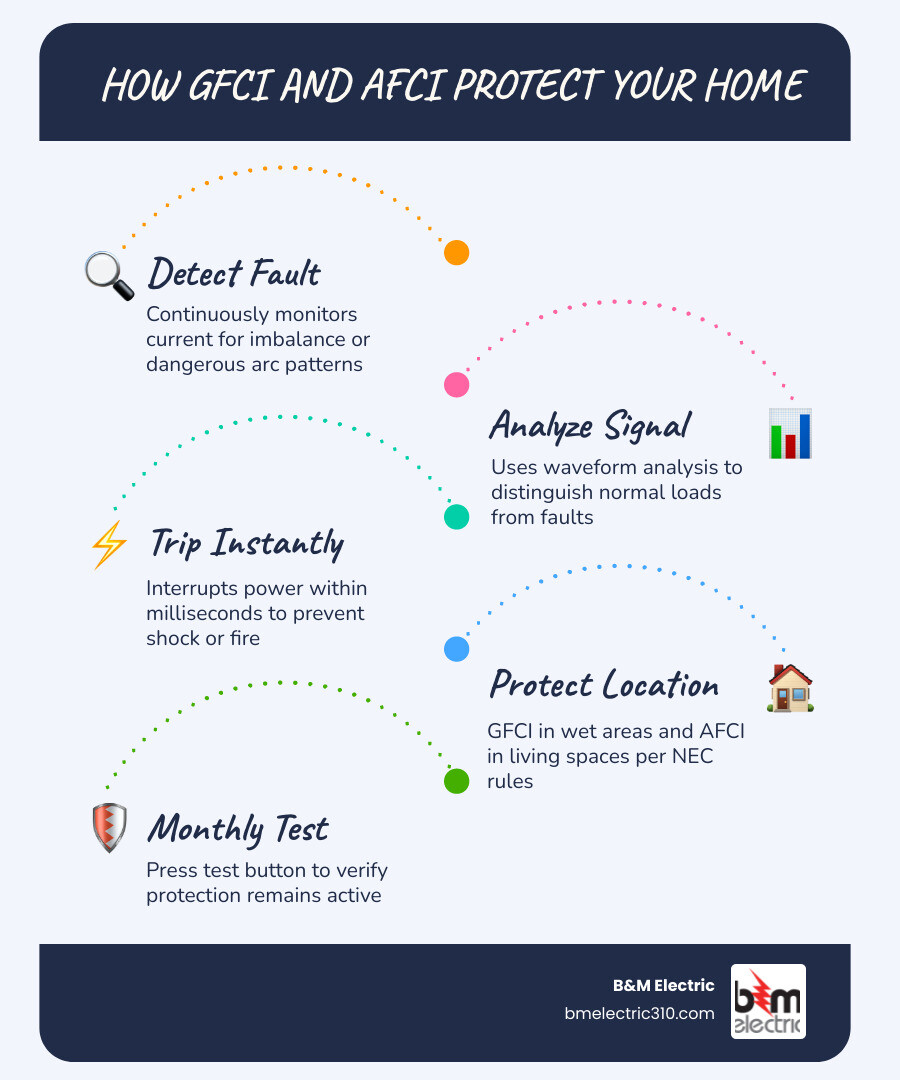
Understanding How GFCI and AFCI Outlets Protect Your Family from Electrical Hazards
At B&M Electric, we’ve spent over 50 years serving the South Bay, and if there is one thing we want our neighbors to know, it’s that electricity is always looking for the easiest path to the ground. Sometimes, that path is through a person or a pile of flammable insulation behind your walls.
Ground Faults: The Shock Risk
A ground fault occurs when electricity escapes its intended path (the wiring) and seeks a shortcut to the ground. This often happens in “wet” areas. For example, if a hair dryer falls into a sink full of water, the water becomes a conductor. If you touch that water, you become the path to the ground. A GFCI outlet acts like a super-fast scale. It constantly monitors the current flowing out of the “hot” wire and back through the “neutral” wire. If it detects a tiny imbalance—as small as 4 to 6 milliamps—it snaps the power off in about 1/40th of a second. That is faster than the blink of an eye and is usually enough to prevent a fatal heart rhythm.
Arc Faults: The Fire Risk
An arc fault is different. It’s an unintended discharge of electricity between two conductors. Think of it like a small lightning bolt occurring inside your wall. These arcs generate intense heat (over 10,000°F), which can easily ignite wood framing or insulation. AFCIs use advanced microprocessor technology to “listen” to the electrical waveform. They can distinguish between a normal arc (like the tiny spark you see when you flip a light switch) and a dangerous, unintended arc caused by a punctured wire or a loose connection. By cutting power before the heat builds up, they prevent fires from ever starting. For more context on staying safe, check out these Essential Electrical Safety Tips.
Comparison Table: GFCI vs. AFCI
| Feature | GFCI (Ground Fault) | AFCI (Arc Fault) |
|---|---|---|
| Primary Goal | Prevent electrocution/shock | Prevent electrical fires |
| Detection Method | Current imbalance (4-6mA) | Waveform analysis (Arcing) |
| Response Time | ~25-30 milliseconds | Instant detection of hazardous arcs |
| Key Danger | Water contact, faulty tools | Damaged wires, loose terminals |
The Critical Differences Between Shock and Fire Protection
It is a common misconception that one device can replace the other. In reality, they are complementary layers of a safety “onion.”
GFCIs are designed to protect people. They are high-sensitivity devices that care about leakage current. If electricity is “leaking” out of the circuit (potentially through you), the GFCI kills the power.
AFCIs are designed to protect property and lives from fire. They care about arcing patterns. A standard circuit breaker only trips if there is a massive overload or a short circuit. However, an arc fault might not draw enough current to trip a standard breaker, but it still produces enough heat to start a fire. AFCIs fill that gap. To ensure your home is fully covered, follow these Tips to Ensure Home Electrical Safety.
How GFCI Outlets Protect Your Family in Wet Areas
Since the early 1970s, the National Electrical Code (NEC) has steadily expanded where GFCIs must be used. Today, they are mandatory in any area where water and electricity might meet:
- Bathrooms: Every single outlet must be protected.
- Kitchens: All receptacles serving countertop surfaces and those within 6 feet of the sink.
- Garages and Basements: These areas often have damp concrete floors, which increase shock risk.
- Outdoors: Whether it’s for holiday lights or power tools, outdoor outlets are exposed to rain and moisture.
When we perform Electrical Safety Tips for Outdoor Living audits, we often find older South Bay homes with standard outlets near pools or patios—a major safety hazard that needs immediate attention.
How AFCI Outlets Protect Your Family from Hidden Fire Risks
While GFCIs guard the “wet” zones, AFCIs guard the rest of the house. Most electrical fires start in the bedroom, living room, or hallways—places where we plug in lamps, chargers, and space heaters.
Common causes of arc faults include:
- Furniture pushing against plugs: Bending the cord until the internal wires fray.
- Nails or screws: Accidentally hitting a wire while hanging a picture.
- Aging insulation: Wiring that has become brittle over decades.
- Rodent damage: Critters chewing on wires in the attic or crawlspace.
By installing AFCI protection, you are essentially putting a “brain” on your circuit that can sense these hidden dangers before they turn into a tragedy.
NEC Requirements and Proper Placement in Your South Bay Home
The National Electrical Code is updated every three years to reflect new safety data. As of the 2023 NEC, requirements for how gfci and afci outlets protect your family have expanded significantly. For example, GFCI protection is now required for many hardwired appliances in kitchens, such as dishwashers.
In places like Torrance, Redondo Beach, and Manhattan Beach, local building departments follow these standards closely. One key rule is that these devices must be “readily accessible.” This means you shouldn’t have to move a heavy refrigerator or use a ladder to reach the “Test” and “Reset” buttons. If your safety devices are buried behind appliances, they aren’t technically up to code. For more localized advice, see our Electrical Safety in Hermosa Beach Tips.
Identifying Missing Protection in Older Homes
Many homes in the South Bay were built in the 1950s and 60s, long before AFCI technology existed and when GFCI rules were in their infancy. If your home has:
- Two-slot outlets: You likely have no grounding and no modern protection.
- Standard outlets in bathrooms: You are at high risk for shock.
- A panel older than 20 years: It likely lacks the ability to detect arc faults.
We recommend a safety audit for any home that hasn’t had an electrical refresh in the last decade. Often, Upgrading to GFCI Outlets is the first and most effective step in modernizing an older home’s safety profile.
The Benefits of Dual-Function Circuit Interrupters
In many modern kitchens and laundry rooms, the code requires both GFCI and AFCI protection. In the past, this meant installing two different devices. Today, we use Dual-Function (DF) breakers or outlets. These combine both technologies into one unit, saving space in your panel and ensuring you meet all safety codes with a single device. This is especially helpful when you want to How to Childproof Your Outlets while also providing maximum fire and shock protection.
Maintenance and Signs You Need an Electrical Upgrade
Like any electronic device, GFCIs and AFCIs can wear out. Most manufacturers recommend testing them monthly.
How to test your outlets:
- Push the “Test” button. You should hear a click, and the “Reset” button should pop out.
- Plug in a small lamp or a tester to verify the power is actually off.
- Push the “Reset” button to restore power.
If the button doesn’t pop out, or if it won’t stay reset, the device has failed and is no longer protecting you. Other warning signs include:
- Nuisance tripping: The breaker trips for no apparent reason (this often indicates a real, hidden fault).
- Discoloration: If the outlet faceplate looks charred or yellowed, it’s overheating.
- Warmth: Outlets should never feel warm to the touch.
- Flickering lights: This is a classic sign of arcing.
If you are experiencing GFCI Outlets That Keep Tripping, don’t just keep resetting it. There is likely an underlying issue that needs a professional eye.
Professional Safety Inspections for South Bay Residents
While DIY testing is great, a professional inspection goes deeper. We check the integrity of the wiring behind the walls, ensure your panel has the capacity for modern loads, and verify that all grounding systems are intact. This is just as important for commercial properties as it is for homes. Businesses can find more information in our Electrical Safety for Businesses Complete Guide.
Frequently Asked Questions about GFCI and AFCI Protection
Can I use a GFCI outlet instead of an AFCI?
No. They are not interchangeable. A GFCI will not detect an arc fault that could start a fire, and an AFCI is not sensitive enough to prevent the specific type of shock that occurs during a ground fault. Think of them like a seatbelt and an airbag—you really want both for full protection.
How often should I test my safety outlets?
We recommend a monthly schedule. A good tip is to test them on the first of every month or whenever you change your HVAC filters. These devices are exposed to power surges and humidity, which can degrade the internal sensors over time.
Why does my GFCI outlet keep tripping?
There are three main culprits:
- A real ground fault: Moisture has entered the box, or an appliance has a “leak.”
- Circuit overload: You have too many high-wattage items plugged into one circuit.
- Faulty device: The GFCI itself has reached the end of its lifespan (usually 10-15 years) and needs replacement.
Conclusion
Ensuring your home is equipped with modern safety devices is one of the best investments you can make for your family’s peace of mind. How GFCI and AFCI outlets protect your family is a story of “invisible” safety—you don’t notice them until the moment they save you from a fire or a dangerous shock.
At B&M Electric, we bring 50 years of local expertise to every job. Whether you need a simple outlet upgrade or a full panel replacement to accommodate new AFCI breakers, our licensed electricians handle every project with precision, care, and a personal touch. We serve Torrance, the South Bay, and all surrounding communities with dependable, high-quality service.
Don’t leave your family’s safety to chance. Contact B&M Electric for South Bay Outlet Services today to schedule a safety audit or upgrade your home’s protection.