How Commercial Electrical Differs from Residential Systems
By B&M Electric May 4, 2026
How Commercial Electrical Differs from Residential: What You Need to Know
How commercial electrical differs from residential comes down to five core areas: power capacity, voltage, wiring methods, safety codes, and system complexity. Here’s a quick breakdown:
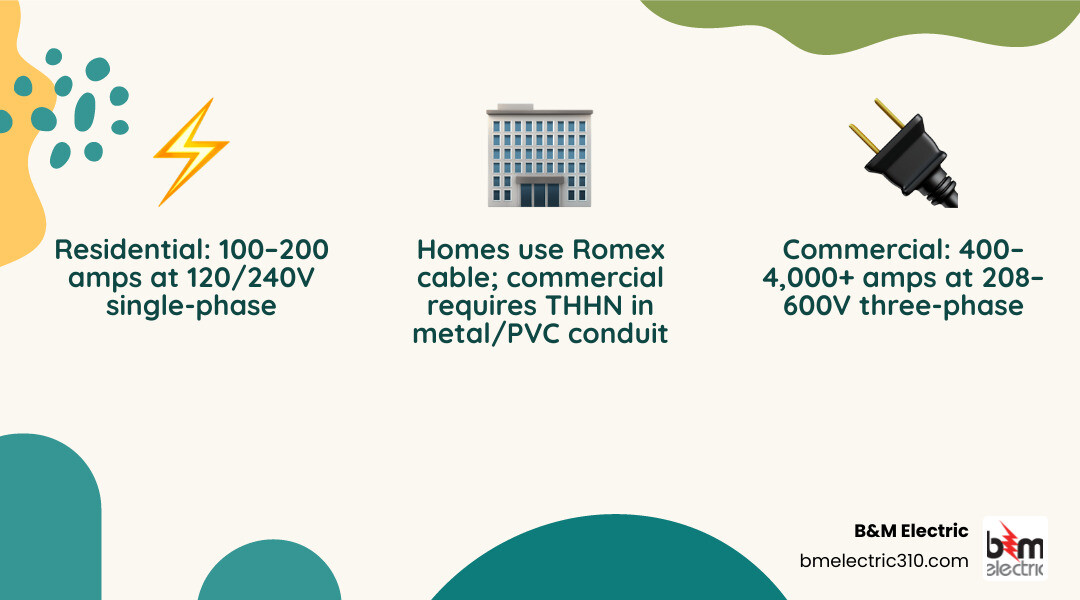
- Power capacity: Residential systems handle 100–200 amps; commercial systems range from 400 to 4,000+ amps
- Voltage: Homes run on 120/240V single-phase; commercial buildings use three-phase power at 208V, 277V, or up to 600V
- Wiring: Homes use Romex (non-metallic cable); commercial buildings use THHN wire inside metal or PVC conduit
- Load demands: A typical home manages 15,000–20,000 watts total load; commercial spaces routinely exceed 100,000 watts
- Codes and compliance: Commercial systems must meet stricter NEC standards, OSHA regulations, and often require annual inspections
Whether you own a home in Torrance or manage a commercial property in the South Bay, understanding these differences helps you ask the right questions — and hire the right electrician.
Think about this contrast: a single-family home typically runs on a 100-amp, 120/240-volt single-phase service. One large industrial building, by comparison, might need three separate 4,000-amp, 480-volt services just to keep the lights on and machinery running. That’s not a small gap — it’s an entirely different world of electrical engineering.
The stakes are higher in commercial settings too. A power failure at home is an inconvenience. A power failure in a hospital, restaurant, or retail space can halt operations, create safety hazards, and cost thousands in lost revenue.
Understanding How Commercial Electrical Differs from Residential Load Demands

When we talk about “load,” we are essentially talking about how much “work” the electricity has to do. In a Torrance home, that work involves keeping the refrigerator cold, the lights on, and perhaps charging an EV or running a pool pump. In a commercial setting, the load is exponentially higher.
A typical residential electrical system manages between 100 and 200 amps. While that is plenty for a family of four, it wouldn’t even power the lobby of a modern South Bay office complex. Commercial power supplies generally start at 200 amps and can easily reach 1,000 to 4,000 amps for large-scale operations.
The difference in wattage is just as staggering. An average home manages a total load of about 15,000 to 20,000 watts. In contrast, a commercial space often exceeds 100,000 watts. To put this in perspective, consider a 750,000-square-foot industrial building. Such a facility might require three separate 4,000-amp, 480-volt services. To handle this, the building might utilize three massive 12,000-volt to 480-volt transformers, each rated at 2.5 MW (megawatts).
Because the loads are so high, energy conservation becomes a massive priority for business owners. We often help clients implement smart technology that can conserve energy by up to 30%. This isn’t just about saving money; it’s about system longevity. You can learn more about these specific needs in our Commercial Electrical Services in Torrance Guide.
| Specification | Residential System | Commercial System |
|---|---|---|
| Typical Amperage | 100 – 200 Amps | 400 – 4,000+ Amps |
| Total Wattage Load | 15,000 – 20,000 Watts | 100,000+ Watts |
| Standard Voltage | 120V / 240V | 208V, 277V, 480V, up to 600V |
| Phase Type | Single-Phase | Three-Phase |
| Wiring Protection | Plastic Sheathing (Romex) | Metal or PVC Conduit |
How Commercial Electrical Differ from Residential Power Phases
One of the most technical ways how commercial electrical differs from residential is the “phase” of the power.
Most homes in the South Bay use single-phase power. This consists of two hot wires and one neutral wire, providing 120V for standard outlets and 240V for heavy appliances like dryers or ovens. It’s efficient for domestic use but can struggle with the massive “inrush” of current required to start large motors.
Commercial buildings almost exclusively use three-phase power. This system uses three hot wires, each carrying alternating current that peaks at different times. This ensures a continuous, non-pulsating flow of power. Three-phase power is significantly more efficient for running large HVAC units and industrial machinery because it prevents the voltage drops that can plague single-phase systems. If you are experiencing flickering lights or tripped breakers at home, you might be dealing with Residential Electrical Issues that are quite different from the phase-balancing problems we see in commercial towers.
Specialized Equipment and High-Voltage Needs
In a residential setting, the most “specialized” equipment we usually see is a high-end kitchen range or a Tesla Wall Connector. In the commercial world, we deal with equipment that has massive appetites for electricity.
Think about elevators in a high-rise, industrial-grade HVAC systems that cool entire floors, and server rooms that must stay powered 24/7. These systems often require 480V or even 600V to operate efficiently. Using lower residential voltages for these machines would require massive, impractical wires and would likely burn out the motors prematurely.
When a business grows, its electrical needs grow with it. We often perform “amp service upgrades” to ensure a building can handle new machinery or expanded office space. This is a job specifically for a Commercial Electrician who understands how to balance these massive loads across a three-phase system.
Wiring Materials and Installation Techniques
If you were to peek behind the drywall of a home in Redondo Beach, you’d likely see “Romex.” This is a non-metallic (NM) sheathed cable. It’s flexible, easy to run through wooden studs, and perfectly safe for residential use. However, you will almost never find it in a commercial building.
Commercial environments are much harsher. Wiring is often exposed to higher heat, mechanical vibration, and the risk of physical damage. This is why we use different materials and techniques for businesses. If you’re planning a home project, you’ll want to work with a Residential Electrician who is an expert in these NM cable installations.
How Commercial Electrical Differs from Residential Wiring Materials
In commercial electrical work, the standard is THHN (Thermoplastic High Heat-resistant Nylon-coated) wire pulled through protective conduit. This conduit can be EMT (Electrical Metallic Tubing), rigid metal, or PVC.
The conduit serves two purposes:
- Protection: It guards the wires against rodents, accidental cuts, and fire.
- Accessibility: It allows us to “pull” new wires through the existing pipes if the business needs to upgrade its tech in the future.
Furthermore, commercial buildings often use plenum-rated insulation. In the event of a fire, this specialized insulation is flame-retardant and emits very little smoke, which is a critical safety requirement for buildings with high occupancy. You can explore our Commercial Services in Torrance CA to see how we apply these heavy-duty materials.
Accessibility and Circuit Design
Another major difference is where the wiring lives. In a home, we hide everything. We want it to be invisible for aesthetic reasons. In a commercial building—especially in “industrial chic” offices or warehouses—you’ll often see exposed conduit running along the ceiling.
This isn’t just a style choice; it’s about modularity. Commercial spaces change constantly. A retail store might need to move its cash wrap, or a warehouse might add a new row of workstations. By using exposed conduit, wire trays, and surface-mounted raceways, we can adapt the electrical layout without tearing down walls.
Dedicated circuits are also much more common in commercial designs. While a single circuit in a house might power three different bedrooms, a commercial kitchen might have a dedicated circuit for every single refrigerator and oven. This prevents a single equipment failure from taking down the entire operation. Our Electrical Services for Torrance Businesses focus heavily on this type of strategic load balancing.
Safety Standards and Code Compliance
Safety is the baseline for everything we do, but the “rulebook” changes depending on the building type. Both residential and commercial work must follow the National Electrical Code (NEC), but commercial projects are subject to additional layers of oversight.
Businesses must comply with OSHA (Occupational Safety and Health Administration) regulations and NFPA 70E standards. These standards focus on protecting employees from “arc flash” incidents—explosive releases of energy that can occur in high-voltage systems. If you’d like to dive deeper, check out our Electrical Safety for Businesses Complete Guide.
Inspection Frequencies and Rigor
For a residential property, an inspection usually only happens during initial construction or when a major permit is pulled for a renovation. Once the “green tag” is issued, the homeowner is generally responsible for their own maintenance.
Commercial properties are different. Because they are open to the public, they often face annual safety inspections. Fire marshals and insurance providers may require proof that emergency lighting, exit signs, and backup power systems are fully functional. This is especially true for Keeping Your Business Up to Code: Commercial Electrical Inspections in Redondo Beach, where local ordinances are strictly enforced to protect the community.
Overcurrent Protection and Monitoring
In a home, your line of defense is the circuit breaker. If you plug in too many hair dryers, the breaker trips, and you go flip it back on. Simple.
In a commercial environment, overcurrent protection is much more sophisticated. We install real-time monitoring systems that can detect minor faults before they become catastrophic failures. Redundancy is also a key factor. In critical facilities like hospitals or data centers, the system is designed so that if one component fails, another immediately takes its place. This level of detail is covered in our Commercial Electrical Inspection Complete Guide.
Frequently Asked Questions
What is the main difference in power phases?
The main difference is efficiency and stability. Residential systems use single-phase power, which is fine for lights and small appliances. Commercial systems use three-phase power, which provides a steady, continuous stream of electricity. This is vital for large motors and continuous loads because it prevents the “voltage drops” that can happen when heavy machinery kicks on.
Why does commercial wiring use conduit instead of Romex?
Commercial wiring uses conduit (metal or PVC pipes) because it offers superior mechanical protection. In a busy warehouse or office, wires are at a higher risk of being pinched or cut. Conduit also acts as a heat sink, helping to dissipate the heat generated by high-voltage loads, and it makes future upgrades much easier since we can pull new wires through existing pipes.
How does maintenance differ for commercial systems?
Residential maintenance is usually “reactive”—you call us when something breaks. Commercial maintenance should be “preventive.” We use tools like thermal imaging to find “hot spots” in panels before they cause a fire. We also perform predictive diagnostics to ensure that your business never faces unexpected downtime. For more on this, see our guide on Commercial Electrical Repair Essential Maintenance for Torrance Businesses.
Conclusion
Understanding how commercial electrical differs from residential is about more than just knowing the lingo; it’s about protecting your investment. Whether you are running a household in the South Bay or a manufacturing plant in Torrance, the electrical system is the heartbeat of your property.
Residential systems are designed for comfort and simplicity, while commercial systems are built for durability, high-capacity performance, and strict legal compliance. At B&M Electric, we’ve spent 50 years mastering both. We bring a personal touch to every job, ensuring that your home feels safe and your business stays productive.
Proper lighting alone can improve employee productivity by up to 20%, and modern smart systems can slash your energy bills. Don’t leave your high-voltage needs to chance. If you’re ready to ensure your property meets the 2026 standards for safety and efficiency, Contact a Commercial Electrician at B&M Electric today. We are proud to serve Torrance and the surrounding South Bay communities with precision and care.