Top Lighting Upgrades That Save Your Business Money
By B&M Electric May 1, 2026
Why Commercial Lighting Upgrades for Energy Savings Are a Smart Business Move
Commercial lighting upgrades for energy savings are one of the fastest ways to cut operating costs in any business. If you want the short answer, here it is:
Top commercial lighting upgrades that reduce energy costs:
- LED retrofits – Replace HID, fluorescent, or incandescent fixtures with LEDs to cut lighting energy use by 40-90%
- Occupancy sensors – Automatically dim or switch off lights in unoccupied areas for an additional 18-32% savings
- Daylight harvesting controls – Adjust light output based on available natural light, saving 12-25% in perimeter zones
- Luminaire Level Lighting Controls (LLLCs) – Sensor-integrated fixtures that can boost savings up to 50% beyond LEDs alone
- Full fixture replacement – Best for aging housings where retrofit kits are not practical
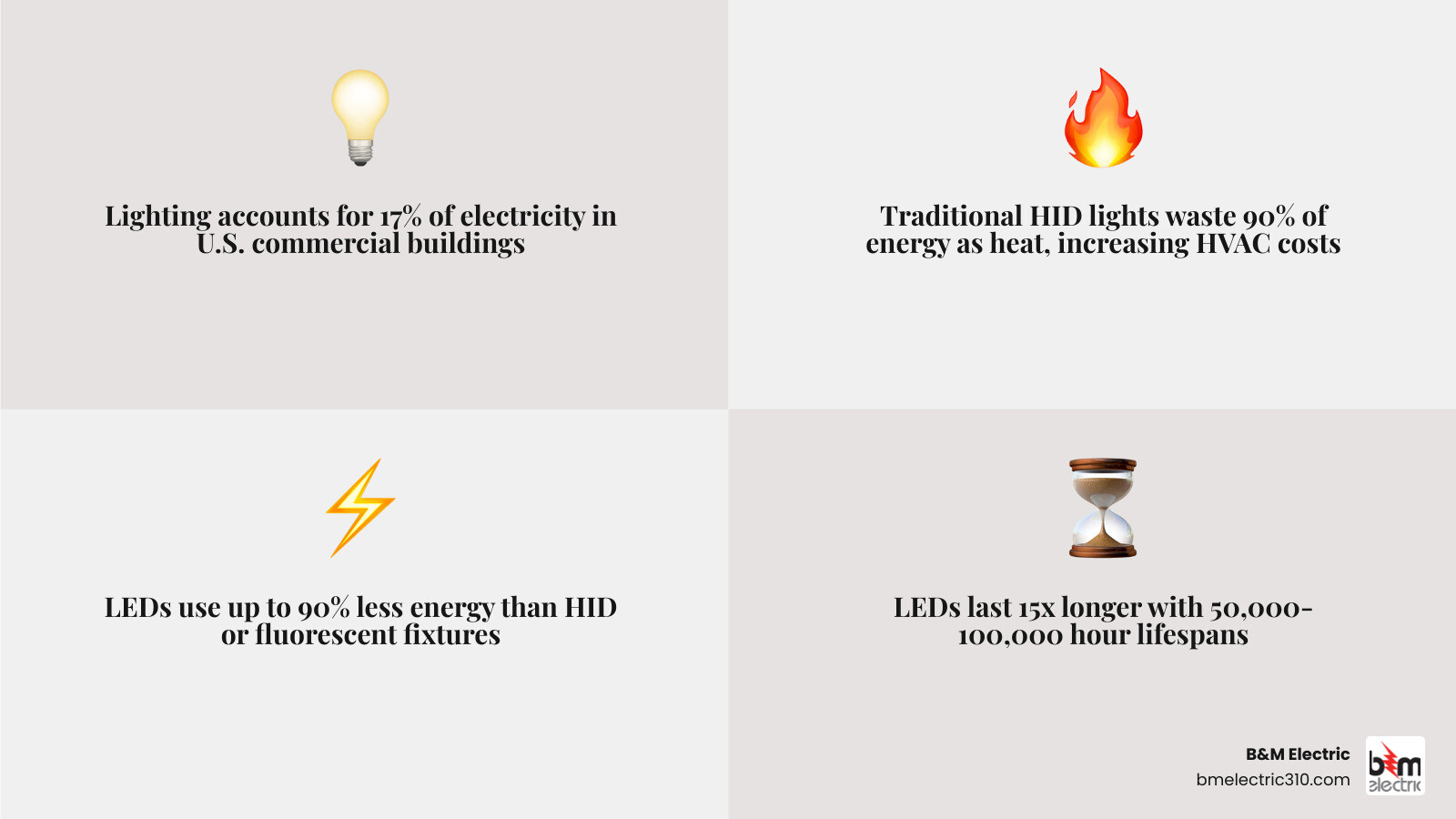
Lighting accounts for 17% of all electricity consumed in U.S. commercial buildings. That is a significant slice of your utility bill — and most of it is being wasted by outdated technology. Older systems like metal halide, high-pressure sodium, and T12 fluorescent fixtures convert a large portion of their energy into heat rather than light, driving up both your lighting and cooling costs at the same time.
Modern LED technology changes that equation dramatically. LEDs use up to 90% less energy than traditional bulbs and last at least 15 times longer, which means lower bills and far fewer maintenance headaches. For businesses in Torrance and the South Bay, where electricity rates are on the higher end, the financial case for upgrading is especially strong.
High-Impact Commercial Lighting Upgrades for Energy Savings
When we talk about high-impact upgrades, we are looking at the heavy hitters of efficiency. Transitioning to LED isn’t just about swapping a bulb; it’s about a fundamental shift in how your facility uses power. As of April 2026, the technology has reached a point where Lower Energy Bills with LED Lighting is a guaranteed outcome for almost any commercial property.
One of the most overlooked benefits of commercial lighting upgrades for energy savings is the reduction in HVAC load. Traditional incandescent bulbs release 90% of their energy as heat, and even CFLs release about 80%. When you have hundreds of these fixtures in a warehouse or office, your air conditioning has to work overtime just to combat the heat generated by your lights. By switching to LEDs, which produce very little heat, you can see a secondary drop in your energy bills—sometimes accounting for up to 300,000 kWh of annual savings in large-scale facilities.
Furthermore, maintenance reduction is a massive “hidden” saving. LEDs are rated for 50,000 to 100,000+ hours. In a typical office setting, that is nearly 20 years of operation without needing a ladder or a scissor lift. For businesses with high ceilings, like those in the South Bay industrial corridors, the labor savings alone can contribute 15-25% of the total project ROI.
Selecting the Best Commercial Lighting Upgrades for Energy Savings
Not all retrofits are created equal. Depending on your existing infrastructure, we usually recommend one of three primary paths to Discover LED Lighting Solutions that fit your specific building.
- Type A (Ballast-Compatible): These are “plug-and-play” lamps that work with your existing fluorescent ballasts. They are the easiest to install but rely on the old ballast staying functional. If the ballast fails, the light goes out.
- Type B (Ballast-Bypass): This is our preferred method for long-term reliability. We remove the old ballast and wire the sockets directly to the building’s voltage. This eliminates a future point of failure and maximizes energy efficiency.
- Type C (External Driver): These systems use a dedicated LED driver located outside the lamp, similar to a ballast but much more efficient. They offer the best dimming performance and are ideal for advanced control integration.
| Retrofit Type | Ease of Installation | Efficiency | Maintenance Needs | Best Use Case |
|---|---|---|---|---|
| Type A | High | Medium | High (Ballast remains) | Short-term budget fixes |
| Type B | Medium | High | Very Low | Long-term warehouse/office |
| Type C | Low | Very High | Low | High-end office/Smart buildings |
Advanced Controls for Commercial Lighting Upgrades for Energy Savings
If LEDs are the engine of energy savings, controls are the steering wheel. You can Save Energy with Dimmer Switches and advanced sensors to ensure you aren’t paying to light empty rooms.
- Occupancy and Vacancy Sensors: These ensure lights are only on when someone is actually in the room. They are perfect for restrooms, breakrooms, and warehouse aisles.
- Daylight Harvesting: These sensors detect natural light coming through windows or skylights and automatically dim the LEDs to maintain a consistent light level, saving up to 25% in perimeter zones.
- Luminaire Level Lighting Controls (LLLCs): This is the gold standard for 2026. Each fixture has its own sensor and “brain,” allowing it to act independently. LLLCs can boost energy savings by up to 50% more than LEDs alone by fine-tuning the light for every square foot of your space.
Technical Specifications for Maximum Efficiency

When selecting products for your commercial lighting upgrades for energy savings, looking at the wattage isn’t enough. In modern Lighting Solutions, efficacy is the metric that matters.
- Luminous Efficacy: Measured in lumens per watt (lm/W). Think of this like MPG for your car. Modern LED high-bays achieve 130-160 lm/W, while old metal halides often struggle to hit 55 lm/W when accounting for ballast loss.
- CCT (Correlated Color Temperature): This determines the “warmth” or “coolness” of the light. For offices, a neutral 4000K is standard, while warehouses often use a crisper 5000K to improve visibility and safety.
- CRI (Color Rendering Index): This measures how accurately the light shows colors. A CRI of 80+ is essential for retail and manufacturing to ensure products look their best and workers can see details clearly.
- DLC Premium: Always look for the DesignLights Consortium (DLC) label. This certification ensures the product meets strict efficiency and quality standards, and it is usually a requirement for qualifying for utility rebates in the South Bay.
Strategic Implementation Across Different Environments
Every business has unique needs, and a “one size fits all” approach rarely works for Custom Lighting Installation Torrance. Here is how we tailor upgrades for specific environments:
- Warehouses: We focus on high-bay retrofits. Replacing a 400W metal halide with a 150W LED UFO fixture delivers an immediate 60-70% energy reduction. Adding occupancy sensors in aisles can push those savings even higher, as lights only “wake up” when a forklift or worker enters the area.
- Cold Storage: LEDs are a miracle for freezers. Unlike fluorescent lights, which struggle to start and lose brightness in the cold, LEDs thrive in low temperatures. They maintain 95%+ output at -5°F and don’t add heat to the refrigerated space, helping your compressors run less often.
- Retail: Here, it’s about the “sales per square foot.” Better lighting quality (high CRI) has been shown to increase retail sales by up to 8% because merchandise looks more vibrant. We often use track lighting and LED panels to create an inviting atmosphere while slashing the bill.
- Offices: The goal is comfort and productivity. We often recommend LED troffer retrofits or flat panels with “task tuning,” which allows us to set the maximum brightness to a comfortable level (often 80%), extending the life of the fixture and saving energy from day one.
Maximizing ROI with Rebates and Incentives
The best part about commercial lighting upgrades for energy savings is that you don’t always have to foot the entire bill yourself. There are numerous Green Energy Savings Tips that involve leveraging utility money.
In our local area, programs like the LADWP Commercial Lighting Incentive Program (CLIP) are game-changers. For commercial customers with monthly use over 200 kW, these incentives can sometimes cover a massive portion of the project cost—in some cases, up to 100% depending on the calculated energy savings. To qualify, you generally need to use DLC-listed equipment and achieve at least 25% energy savings, which is easily doable with a professional LED retrofit.
Beyond utility rebates, there is the Section 179D Tax Deduction. This federal incentive allows building owners to claim a deduction for energy-efficient lighting systems that reduce energy use. When you combine rebates, tax deductions, and the 40-60% drop in your monthly utility bill, the simple payback period for these projects often falls between 1.8 and 2.7 years. Over a 10-year period, the ROI can exceed 450%.
Conclusion
Upgrading your commercial lighting is more than just a maintenance task; it’s a strategic investment in your business’s bottom line. At B&M Electric, we bring 50 years of local expertise to every project in Torrance and the South Bay. We understand the specific needs of our coastal climate and the local utility landscapes, ensuring your upgrade is handled with precision and care.
Whether you are managing a 50,000-square-foot warehouse or a boutique retail space, we are here to help you navigate the technical specs and rebate applications to maximize your savings. Ready to see the difference professional lighting can make? Explore our Commercial Electrician Services today and let’s start saving you money.
How long do commercial LED lights typically last?
Commercial-grade LEDs are designed for longevity, typically rated between 50,000 and 100,000+ hours. To put that in perspective, if your business operates 12 hours a day, 365 days a year, a 50,000-hour LED will last over 11 years. A 100,000-hour light could last nearly 23 years. This longevity virtually eliminates the constant cycle of lamp replacements, significantly lowering your long-term maintenance costs.
What is the difference between a retrofit kit and a new fixture?
A retrofit kit allows you to keep your existing light fixture “housing” but replaces the internal components (the light source and the driver) with LED technology. This is often faster and more cost-effective. A full fixture replacement involves removing the entire old unit and installing a brand-new LED luminaire. We usually recommend full replacement if your existing housings are damaged, yellowed, or if you want to change the aesthetic layout of your lighting.
Can I install LED retrofits myself?
While it might be tempting to treat a commercial retrofit like a home DIY project, we strongly advise against it. Commercial systems involve higher voltages (277V or 480V) and complex wiring that require a licensed professional to ensure safety and code compliance. Furthermore, most utility rebate programs, like those from LADWP, require professional installation and pre-approval to qualify for the money. Hiring a certified team like B&M Electric ensures your warranty remains valid and your building stays up to code.