Why an Electrical Inspection Reveals Hidden Panel Problems
By B&M Electric June 30, 2026
Why an Electrical Inspection Reveals Hidden Panel Problems
Why an Electrical Inspection Reveals Hidden Panel Problems
Why an electrical inspection reveals hidden panel problems is something every Torrance and South Bay homeowner should understand — because the most dangerous electrical hazards are often the ones you can never see.
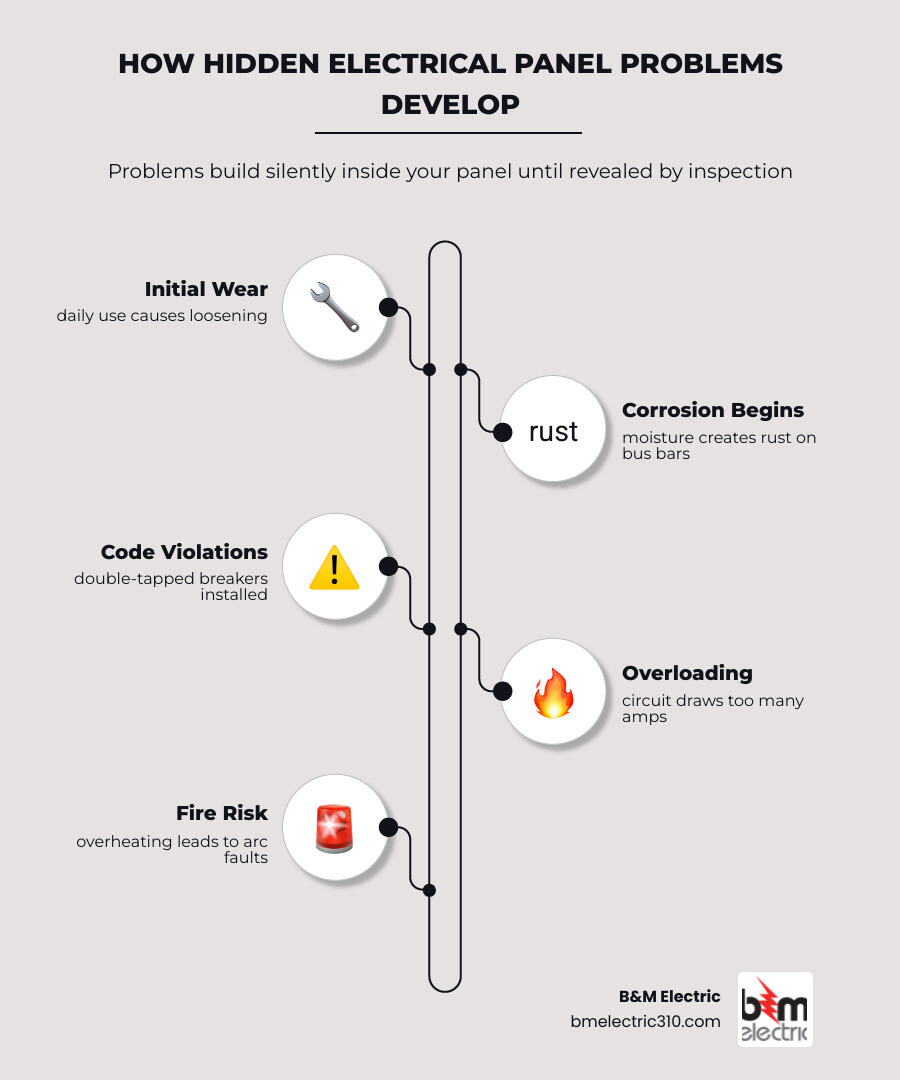
Your electrical panel sits behind a metal cover, quietly managing every circuit in your home. From the outside, it can look perfectly fine. But inside, problems like corroded bus bars, double-tapped breakers, overloaded circuits, and failing components from recalled panel brands can be building toward a serious safety event — and you’d have no idea.
Here’s a quick look at what a professional electrical inspection uncovers that homeowners typically miss:
- Overloaded circuits — circuits carrying more current than they were designed to handle, increasing fire risk
- Double-tapped breakers — two wires sharing a single breaker slot, a common code violation that causes overheating
- Recalled or hazardous panel brands — Federal Pacific Stab-Lok, Zinsco, and Pushmatic panels have documented failure rates that make them serious fire risks
- Corroded or loose bus bar connections — internal corrosion and loose terminations that standard visual checks never catch
- Improper grounding and bonding — missing or faulty grounding that increases shock and fire risk
- Moisture intrusion — water inside the panel cabinet that accelerates corrosion and creates shock hazards
- Missing or inaccurate circuit labeling — unlabeled panels that mask dangerous wiring configurations
According to the U.S. Consumer Product Safety Commission, home electrical system failures cause over 50,000 fires annually in the United States, resulting in more than 500 deaths and $1.3 billion in property damage. Many of those fires start inside electrical panels — in places no homeowner ever thinks to look.
A licensed electrician performing a thorough inspection uses specialized tools and training to get inside the panel safely, assess what’s actually happening, and flag problems before they escalate into emergencies.
Handy why an electrical inspection reveals hidden panel problems terms:
When most people think of home maintenance, they think of visible tasks: painting the walls, clearing the gutters, or fixing a leaky faucet. But your electrical system is different. It operates entirely behind drywall and inside metal enclosures.
A standard homeowner’s visual check of an electrical panel is usually limited to looking at the outside of the metal box or opening the door to see if a breaker has tripped. However, this surface-level check is highly deceptive.
The National Fire Protection Association (NFPA) notes that electrical failures or malfunctions are a leading cause of home structure fires, contributing to tens of thousands of incidents annually. A significant portion of these disasters could be prevented if homeowners understood that outward appearances do not reflect internal safety.
A professional Electrical Inspections Safeguarding Home procedure is specifically designed to bypass this false sense of security. By using advanced diagnostic tools and following structured safety protocols, licensed electricians can see through the metal and drywall to diagnose exactly how your system is performing under load.
Why an electrical inspection reveals hidden panel problems before they cause fires
Inside your electrical panel, electricity flows through a complex network of copper or aluminum bus bars, circuit breakers, and tightly torqued terminal lugs. Over time, physical and environmental factors can compromise these components, quietly creating extreme fire hazards.
- Overloaded Circuits: Modern lifestyles put immense stress on older electrical systems. In June 2026, the average South Bay household runs high-power appliances, electric vehicle (EV) chargers, smart home systems, and multiple air conditioners. When a circuit is chronically overloaded, it generates excess heat. Over time, this heat degrades the wire insulation, turning a standard wire into a potential ignition source.
- Arc Faults: An arc fault occurs when electrical current flows through an unintended path—often caused by damaged, frayed, or loose wiring. These arcs can reach temperatures of several thousand degrees Fahrenheit, easily igniting nearby combustible materials. Standard breakers only detect overloads and short circuits; they do not detect dangerous low-level arcing.
- Loose Wiring: Due to the natural expansion and contraction of metals as they heat up and cool down (thermal cycling), screw connections on breakers and bus bars can loosen over time. A loose wire creates high resistance. High resistance generates intense local heat, which can melt the breaker, damage the bus bar, and start a fire without ever tripping the breaker.
During a professional inspection, we look for these thermal anomalies and physical signs of deterioration. If you have noticed any flickering lights, warm switches, or strange buzzing sounds, these are immediate indicators that you should consult our guide on Signs Your Home Needs Electrical Repair to understand what your system might be trying to tell you.
Why an electrical inspection reveals hidden panel problems that standard home inspections miss
When buying or selling a home in the South Bay, a general home inspection is a standard part of the real estate transaction. However, many buyers do not realize that a general home inspector has strict legal and professional limitations. In many jurisdictions, general home inspectors are prohibited from removing the “dead front”—the metal cover that shields the live wires inside the panelboard. They are only licensed to perform a non-invasive, visual assessment of the exterior.
Because general home inspectors cannot safely open the panel, they cannot see:
- Bus Bar Corrosion: Moisture entering the panel from deteriorated utility service masts can cause hidden rust and corrosion directly on the power-distribution bus bars.
- Double-Tapped Breakers: This occurs when an amateur installer connects two separate electrical wires under a single screw terminal on a breaker not rated for two wires. This loose connection leads to overheating and arcing.
- Amateur Modifications: Unpermitted, DIY wiring additions often lurk inside the panel cabinet, completely hidden from view until the cover is removed.
A licensed electrician possesses the specialized personal protective equipment (PPE) and training required to safely remove the dead front, perform dynamic load testing, and inspect the internal bus bars. To understand the exact steps and safety protocols involved in this process, read our comprehensive guide on Power Up Your Peace of Mind: What to Expect from a Home Electrical Inspection in Torrance.
Outdated Panel Brands and Legacy Hazards in Older South Bay Homes
The South Bay area is famous for its beautiful historic homes, but older properties in Torrance, Redondo Beach, and Manhattan Beach often harbor obsolete electrical infrastructure. In the mid-to-late 20th century, several electrical panel brands were installed in millions of homes that are now recognized as extremely hazardous.
If your home was built between 1950 and 1990, there is a high probability that you have one of these legacy systems.
| Legacy Panel Brand | Active Years | Primary Safety Defects & Hazards | Recommended Action |
|---|---|---|---|
| Federal Pacific (FPE) Stab-Lok | 1950s – 1980s | Breakers fail to trip under overload or short circuit; breakers can detach from the bus bar; high rate of internal arcing. | Immediate replacement with a modern, UL-listed panel. |
| Zinsco / Sylvania-Zinsco | 1950s – 1970s | Breakers fuse directly to the copper bus bar, preventing them from tripping; bus bars are highly susceptible to corrosion. | Immediate replacement to eliminate severe fire risks. |
| Pushmatic (Bulldog) | 1950s – 1970s | Push-button mechanisms become stiff and fail to operate; internal grease hardens over time, preventing mechanical tripping. | Upgrade to a modern thermal-magnetic breaker panel. |
| Traditional Fuse Boxes | Pre-1960s | Easily bypassed by homeowners using oversized fuses; lack of modern safety devices like GFCIs/AFCIs; capacity is insufficient for modern loads. | Full panel and service upgrade to at least 100A or 200A. |
If you suspect your home still relies on one of these obsolete systems, we highly recommend reading our detailed warning guide: Don’t Get Zapped by an Old Electrical Panel.
The Danger of Breakers That Fail to Trip
The primary job of a circuit breaker is to act as a safety valve. If a wire carries too much current, or if a short circuit occurs, the breaker is designed to trip instantly, cutting off the power supply before the wire can overheat and catch fire.
With dangerous legacy brands like Federal Pacific Stab-Lok and Zinsco, independent testing has shown that these breakers fail to trip at alarmingly high rates. In a standard home, if a hair dryer or space heater draws too much power, a modern breaker trips. In an FPE Stab-Lok panel, the breaker may simply remain closed, allowing the wire to heat up to red-hot temperatures behind your walls.
Because these components are obsolete, finding legitimate replacement parts is nearly impossible. Homeowners who try to swap out individual broken breakers on these panels are often installing refurbished parts that carry the exact same design flaws.
To protect your household from these silent failures, explore our guide on Signs Your Electrical Panel Needs Upgrade to identify when it is time to transition to a modern, reliable system.
Common Code Violations and Safety Risks Uncovered by Inspectors
During a professional electrical safety audit, our electricians reference the National Electrical Code (NEC) alongside local building amendments in California. We frequently find code violations that pose direct safety risks to the home’s occupants.
- Improper Grounding and Bonding: Grounding is the single most important safety mechanism in your home’s electrical system. It provides a safe path for fault current to return to the earth, preventing severe shocks. We often find missing grounding electrodes, loose ground clamps, or unbonded metal water pipes.
- Subpanel Neutral and Ground Separation: At the main electrical panel, the neutral (white) wires and ground (bare/green) wires are bonded together. However, at any subpanel downstream, these wires must remain strictly separated. If they are bonded at a subpanel, it creates a parallel path for neutral current, energizing the metal casing of the panel and creating a major shock hazard.
- Double-Tapped Breakers: As shown in the image above, squeezing two wires under one terminal screw is a major safety hazard. Over time, one of the wires will inevitably loosen, leading to localized arcing and overheating.
Keeping your home compliant with the latest safety standards is crucial. If you want to ensure your system is up to current standards, consider scheduling an Electrical Code Audit Torrance with our experienced team.
Working Clearance and Dedicated Space Violations
The National Electrical Code (NEC 110.26) mandates strict clearance rules around electrical panels to ensure that technicians have safe, unobstructed access in the event of an emergency.
Specifically, the code requires a working space that is at least:
- 36 inches deep in front of the panel.
- 30 inches wide (or the width of the equipment, whichever is greater).
- 6.5 feet high from the floor.
- The panel door must be able to open to at least a 90-degree angle.
Common violations we uncover in South Bay homes include panels hidden inside tight clothes closets (which are highly combustible environments), panels blocked by heavy storage shelves in garages, and panels located directly under plumbing lines where water leaks could cause catastrophic failures.
To learn more about how to prepare your home and ensure your panel meets these critical physical safety requirements, check out our Home Electrical Inspection South Bay Guide.
The Financial and Insurance Impact of Hidden Panel Issues
Ignoring your electrical panel doesn’t just put your safety at risk—it can also severely impact your wallet. In June 2026, insurance companies are more stringent than ever before. Many major homeowners insurance providers in California perform risk assessments and will outright deny coverage or refuse to renew policies for homes containing known hazardous panels like Federal Pacific or Zinsco.
If an electrical fire occurs and an investigation reveals that the fire originated from an unpermitted, outdated, or poorly maintained electrical panel, the insurance company may deny the claim entirely. This leaves the homeowner solely responsible for hundreds of thousands of dollars in property damage.
Furthermore, hidden panel issues can derail real estate transactions. If a buyer’s inspector flags a faulty or outdated panel, it can delay the closing process, lower your property value, or force you to make hasty, expensive upgrades under tight escrow deadlines.
Investing in timely Electrical Panel Upgrades ensures your home remains fully insurable, maintains its market value, and is ready for modern electrical demands.
Preventing Costly Emergency Repairs Through Proactive Audits
No one wants to deal with an electrical emergency, especially when it happens during a busy week or over a holiday. Emergency electrical repairs are not only stressful, but they also carry premium costs.
A proactive electrical safety audit acts as preventive maintenance for your home. By identifying loose connections, minor corrosion, or slight overloads early, you can schedule repairs at your convenience rather than waiting for a complete system failure. Proactive maintenance also extends the overall lifespan of your appliances, as stable voltage levels prevent sensitive electronics from experiencing premature wear and tear.
To discover how regular check-ups keep your home running smoothly and efficiently, read about how Electrical Inspections Prevent Issues before they turn into costly disasters.
Frequently Asked Questions About Electrical Panel Inspections
How often should South Bay homeowners schedule a panel inspection?
We recommend that homeowners follow a structured maintenance schedule based on the age of their home:
- Homes under 10 years old: Every 5 to 7 years.
- Homes between 10 and 25 years old: Every 3 to 5 years.
- Homes older than 25 years: Every 1 to 3 years.
Additionally, you should always schedule an inspection immediately after purchasing a new home, before undertaking major renovations, or when adding high-load appliances like EV chargers, hot tubs, or heat pumps. For local support in the Torrance area, you can learn more about our dedicated Electrical Panel Inspection Torrance services.
What are the immediate warning signs of a failing electrical panel?
While many panel problems are hidden, you should contact a licensed electrician immediately if you notice any of the following warning signs:
- Flickering or dimming lights when major appliances turn on.
- A panel cover that feels warm to the touch.
- A persistent burning plastic or sulfur-like smell near the panel.
- Circuit breakers that trip frequently under normal household loads.
- Hissing, crackling, or buzzing sounds coming from inside the panel cabinet.
Can I inspect my own electrical panel to find hidden problems?
No. Homeowners should never attempt to remove the dead front cover or inspect the internal components of an electrical panel themselves.
The interior of an electrical panel contains fully energized bus bars and live lugs that carry fatal levels of voltage. Touching these components, or even accidentally dropping a tool inside, can trigger a catastrophic arc flash—an explosive release of electrical energy that can exceed temperatures of 35,000°F, causing severe burns, blindness, or electrocution.
Professional electricians undergo years of training, use specialized safety gear (including insulated tools and voltage testers), and wear safety equipment to perform these diagnostics without risk.
Conclusion
Your electrical panel is the heart of your home’s electrical system. Keeping it in top condition is essential for protecting your property, your family, and your peace of mind.
At B&M Electric, we have spent over 50 years serving homeowners and businesses in Torrance and the surrounding South Bay communities. Our family-owned business prides itself on providing dependable service with a personal touch. We emphasize precision, care, and a worry-free customer experience, ensuring that your home’s electrical system is safe, efficient, and fully compliant with all modern safety codes.
Don’t wait for a hidden panel problem to turn into an expensive emergency. Schedule your professional electrical panel inspection with B&M Electric today and let our experienced, licensed team give your home the thorough, expert care it deserves.