How to Determine When to Upgrade from 100 Amp to 200 Amp Service
By B&M Electric June 23, 2026
How to Determine When to Upgrade from 100 Amp to 200 Amp Service
Is It Time to Upgrade from 100 Amp to 200 Amp Service in Your South Bay Home?
Knowing when to upgrade from 100 amp to 200 amp service is one of the most important decisions a homeowner can make for safety, reliability, and future-proofing their home. If your house was built before 1990, there is a good chance it still runs on a 100-amp panel — a setup that was perfectly fine decades ago, but one that today’s electrical demands can push to its limits fast.
Here are the most common signs it is time to upgrade:
- Breakers trip frequently, especially when running multiple appliances at once
- Lights dim or flicker when your AC, refrigerator, or other large appliances kick on
- You are planning to install a Level 2 EV charger, heat pump, or induction range
- Your panel is full with no open circuit spaces for new circuits
- You are remodeling, adding a room, or converting gas appliances to electric
- Your panel is more than 25–30 years old, or is a known problem brand like Federal Pacific or Zinsco
- You smell burning, hear buzzing, or notice warmth near the panel
If any of these apply to your home in Torrance or the South Bay, a 200-amp service upgrade is likely the right move — and the sooner you act, the safer your home will be.
Many older South Bay homes were wired for a simpler time. Back then, a 100-amp service handled a few lights, a refrigerator, and maybe a window AC unit. Today, homes are running central HVAC, electric ranges, EV chargers, home offices, and smart devices — all at once. That is a completely different electrical reality, and a 100-amp panel was simply never designed for it.

Simple guide to when to upgrade from 100 amp to 200 amp service:
- electrical panel upgrade benefits for homeowners
- electrical panel upgrade process what to expect
- how a modern panel improves your home safety
Understanding Electrical Capacity: 100 Amp vs. 200 Amp Service
To understand why your electrical panel might be struggling, it helps to understand what “amperage” actually means. Think of your home’s electrical system like the plumbing in your house. Voltage is the water pressure, while amperage (amps) is the volume of water flowing through the pipes.
A 100-amp service is like a standard garden hose. It provides plenty of water to water your lawn, but if you try to wash your car, run the sprinklers, and fill a swimming pool all at the same time, the pressure drops to a trickle. A 200-amp service is more like a high-volume fire hose. It delivers twice the volume of electricity, allowing you to run multiple high-demand appliances simultaneously without a hitch.
In terms of raw power, here is how the math breaks down:
- 100-Amp Service: Delivers approximately 24,000 watts of electrical capacity (100 amps x 240 volts).
- 200-Amp Service: Delivers approximately 48,000 watts of electrical capacity (200 amps x 240 volts).
However, you cannot safely use 100% of that capacity all the time. The National Electrical Code (NEC) mandates the 80% rule for continuous loads. This means that a circuit or an entire panel should only be subjected to 80% of its maximum rating for continuous use (loads that run for three hours or more).
Under this rule, a 100-amp panel can only safely handle 80 amps of continuous load (19,200 watts). A 200-amp panel, on the other hand, safely accommodates 160 amps of continuous load (38,400 watts). If you are adding modern, high-draw appliances, that extra breathing room is not just convenient — it is a safety requirement.
| Feature | 100-Amp Service | 200-Amp Service |
|---|---|---|
| Total Wattage Capacity | 24,000 Watts | 48,000 Watts |
| Max Continuous Load (80% Rule) | 19,200 Watts (80 Amps) | 38,400 Watts (160 Amps) |
| Typical Number of Circuit Slots | 20 to 30 spaces | 40 to 42 spaces |
| Suitability | Small homes with gas appliances | Modern homes, EV charging, all-electric appliances |
| Future-Proofing | Extremely limited | High (supports solar, batteries, and smart home additions) |
If you are trying to determine if your current setup is up to par, our comprehensive Electrical Service Panel Replacement Guide covers the fundamental differences in depth.
How to Know When to Upgrade from 100 Amp to 200 Amp Service
Determining when to upgrade from 100 amp to 200 amp service comes down to observing how your home handles its current electrical load and anticipating your future needs.
The most common sign that your panel is maxed out is a frequent breaker trip. Breakers are safety switches designed to shut off power when a circuit is carrying more current than it can safely handle. If running your microwave while the vacuum cleaner is on causes a trip, your system is crying out for help.
Another classic symptom is a voltage drop, which you will notice when your lights momentarily dim or flicker the second your central air conditioner or refrigerator compressor kicks on. This happens because the appliance is drawing a massive amount of “startup” current, leaving temporary crumbs for the rest of your home’s lighting.
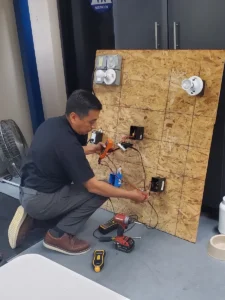
If you are constantly dealing with these issues, you can learn more about identifying these red flags in our guide on Signs You Need an Electrical Panel Upgrade.
Immediate Warning Signs in Your South Bay Home
While flickering lights are annoying, some signs point to immediate fire hazards that require urgent attention. If you notice any of the following, do not wait to schedule an inspection:
- A Warm Panel: Touch the cover of your electrical panel. It should feel cool to the touch. If it feels warm or hot, circuits are overloading and generating dangerous heat.
- Burning Smells: A sweet, plastic-like, or smoky odor near your panel or outlets is a sign that wire insulation is melting. This is an active electrical fire risk.
- Buzzing or Crackling Sounds: If your panel is making noise, it often indicates “arcing,” where electricity is jumping between loose connections.
- Rust and Corrosion: Here in the South Bay, our beautiful coastal air in Redondo Beach, Hermosa Beach, and Manhattan Beach carries moisture and salt. Over time, this can lead to rust and corrosion inside outdoor panels, which degrades connections and increases electrical resistance.
Furthermore, if your home still uses older panel brands like Federal Pacific Electric (FPE) or Zinsco, these are notorious for failing to trip during an overload, leading to devastating house fires. Replacing these is a safety priority regardless of your current electrical load. Our specialized guide on Resolving Overloaded Electrical Panels outlines exactly how to handle these urgent safety hazards.
Lifestyle Changes That Dictate When to Upgrade from 100 Amp to 200 Amp Service
Sometimes, your panel is working perfectly fine today, but major life changes mean it won’t be able to handle tomorrow.
Are you planning a home renovation? Adding a master suite, finishing an attic, or building an Accessory Dwelling Unit (ADU) will drastically increase your power requirements. A kitchen remodel that introduces a high-power induction cooktop, a double wall oven, and a commercial-grade refrigerator will easily push a 100-amp panel past its safe operating limits.
Even setting up a dedicated home office with multiple monitors, servers, and high-end computers can add a steady, continuous draw to your system. Before starting any construction, read through our resource on Electrical Panels and Home Renovations Assessing to see how your plans will impact your electrical infrastructure.
Supporting Modern Electrification: EV Chargers, Heat Pumps, and Remodels
California is leading the charge in home electrification. With state and local mandates encouraging homeowners to transition away from natural gas, the demands on our home electrical grids have never been higher.
Replacing a gas furnace with an energy-efficient electric heat pump, swapping a gas water heater for a hybrid heat pump model, and replacing a gas stove with an induction range are incredible steps for the environment and indoor air quality. However, these modern appliances are heavy electricity consumers.
An induction range alone can demand 40 to 50 amps of capacity. A heat pump in peak heating or cooling mode can pull 30 to 50 amps. If you try to run these on a 100-amp panel alongside your lighting, entertainment systems, and laundry, you will quickly exceed your limit.
Upgrading to a 200-amp panel is the standard foundation required to support these eco-friendly upgrades safely. You can read more about how this transition works in our article on the 200 Amp Service Upgrade.
Why EV Charging Triggers the Need to Upgrade from 100 Amp to 200 Amp Service
If there is one single appliance that forces homeowners to ask when to upgrade from 100 amp to 200 amp service, it is the electric vehicle (EV) charger.
While you can plug an EV into a standard 120-volt household outlet (Level 1), it charges at an agonizingly slow rate of about 3 to 5 miles of range per hour. To get a full charge overnight, you need a Level 2 EV charger, which runs on a 240-volt circuit.
Most Level 2 chargers require a dedicated 50-amp or 60-amp circuit breaker. Because EV charging is considered a continuous load (it runs for hours at a time), the charger will continuously draw 40 amps of power on a 50-amp circuit.
If your total household capacity is only 100 amps, charging your car will instantly consume 40% to 50% of your home’s entire electrical capacity. If your air conditioner kicks on while you are charging your car and cooking dinner, your main breaker will trip, leaving you in the dark.
Before installing an EV charger, a professional load calculation must be performed to see if your current panel can legally and safely support the new demand. If you want to see what this process looks like, check out our guide on How to Upgrade to 200 Amp Service in 7 Simple Steps.
Service Upgrade vs. Panel Upgrade: What is the Difference?
A common point of confusion for many homeowners is the difference between a panel upgrade and a service upgrade.
- Electrical Panel Upgrade: This involves replacing your existing breaker box with a new, modern one. You might do this because your old panel is full, outdated, or unsafe (like an old Zinsco panel), but you keep the same overall capacity (e.g., staying at 100 amps). This gives you more circuit slots and improved safety, but does not increase the total amount of power coming into your home.
- Electrical Service Upgrade: This increases the actual volume of power delivered to your home from the utility company (moving from 100 amps to 200 amps). This is a much larger project. It requires replacing the panel, but also upgrading the service entrance conductors (the heavy-duty wires running from the utility pole or underground vault to your house), replacing the meter base (the outdoor enclosure holding the utility meter) to handle the higher amperage, and installing a new main 200-amp breaker.
A service upgrade requires extensive coordination with your local utility provider (such as Southern California Edison) to disconnect the power, verify the supply lines can handle the load, and reconnect the system once the work is complete. You can explore the nuances of this distinction in our Electrical Panel Replacement Guide.
The Service Upgrade Process in Torrance and the South Bay
Upgrading your electrical service in Torrance or the surrounding South Bay cities is a highly regulated process that requires professional expertise. This is not a project for DIY enthusiasts or unlicensed handymen; working with live utility lines carries extreme safety risks, and local cities strictly enforce building codes.
Here is what the professional upgrade process looks like when you work with us:
- Load Calculation and Planning: We inspect your current electrical system, perform a comprehensive load calculation according to the National Electrical Code, and determine the optimal layout for your new 200-amp panel.
- Permit Acquisition: We handle all the paperwork and submit detailed plans to the local building department (such as Torrance, Redondo Beach, or Los Angeles County) to secure the necessary electrical permits.
- Utility Coordination: We coordinate with Southern California Edison (SCE) to schedule a disconnect-reconnect date and ensure their incoming service lines are rated to support 200 amps.
- Physical Installation: On the day of the upgrade, we safely disconnect your old panel, install the new 200-amp outdoor meter socket and panel box, run new, thicker service entrance conductors, and upgrade your home’s grounding system. This usually involves driving two 8-foot copper grounding rods deep into the earth to meet modern safety codes.
- City Inspection: Once the installation is complete, a city building inspector must review the work to ensure it complies with all local and national electrical codes.
- Utility Reconnect: After the city inspector signs off and issues a “green tag,” SCE will return to reconnect the main power lines to your home and install your new smart meter.
To understand the specific local regulations and steps involved in our area, take a look at our Torrance Electrical Panel Upgrade Guide.
Frequently Asked Questions About Electrical Service Upgrades
Is a 100-amp service still adequate for some homes?
Yes, a 100-amp service can still be perfectly adequate for certain homes. If you live in a smaller condo, townhome, or a historic cottage with gas heating, a gas water heater, a gas range, and no central air conditioning or electric vehicle charging needs, your continuous electrical draw is likely very low.
However, as California continues to push for gas-to-electric conversions, staying on a 100-amp panel limits your ability to make future home improvements. If you live in Hermosa Beach or surrounding areas, you can learn more about local considerations in our Electrical Panels Hermosa Beach CA Guide.
When does a home require a 400-amp service instead of 200-amp?
While 200 amps is the modern gold standard for most residential properties, some homes require a 400-amp service (often set up as two 200-amp panels side-by-side). You should consider a 400-amp upgrade if:
- Your home is larger than 4,000 square feet.
- You plan to install multiple Level 2 EV chargers (e.g., charging two electric vehicles simultaneously at full speed).
- You have high-draw luxury amenities like an electric pool heater, a large hot tub, or a sauna.
- You are building a guest house, ADU, or detached workshop with heavy machinery.
- You are integrating a massive solar panel system with multiple backup battery storage units.
For properties in upscale neighborhoods with extensive power demands, our Home Electrical Panels Palos Verdes Guide provides excellent insights into when a 400-amp upgrade is the right choice.
How long does the power outage last during a service upgrade?
On the day of the actual panel swap and service upgrade, your power will need to be completely shut off for safety. Typically, the physical installation work takes our team about 6 to 8 hours to complete.
We work efficiently to minimize disruption, planning the outage during daylight hours so you can plan accordingly. Once the work is done and the city inspector approves the installation, the utility company will restore your power. To learn more about preparing your home for inspection day, check out our resource on Electrical Panel Inspection Torrance.
Conclusion
Upgrading from a 100-amp to a 200-amp service is one of the smartest investments you can make for your home. It eliminates the daily frustration of tripped breakers and flickering lights, protects your family from the fire hazards of overloaded older panels, and provides the essential foundation needed for modern amenities like Level 2 EV chargers, heat pumps, and solar power.
At B&M Electric, we bring 50 years of local expertise to every single project. As a family-owned business serving Torrance, CA, and the surrounding South Bay communities, we pride ourselves on delivering dependable service with a personal touch. We manage the entire process for you — from the initial load calculations and city permits to coordination with Southern California Edison and the final code inspections — ensuring a seamless, worry-free experience.
Ready to find out if your home is ready for a power boost? Explore our specialized services for Electrical Panels Torrance CA and contact us today to schedule your professional home electrical capacity assessment!