Level 1 vs Level 2 EV Charger: Speed & Cost Compared
By B&M Electric June 24, 2026
Level 1 vs Level 2 EV Charger: Speed & Cost Compared
Is Your Home Charger Fast Enough? A Level 1 vs Level 2 EV Charger Comparison
The level 1 vs level 2 EV charger comparison comes down to one simple question: does your charger keep up with how much you drive?
Here is a quick side-by-side answer:
| Feature | Level 1 | Level 2 |
|---|---|---|
| Voltage | 120V | 240V |
| Range added per hour | 2–5 miles | 12–60 miles |
| Full charge time (BEV) | 40–50+ hours | 4–10 hours |
| Installation needed | None (standard outlet) | Yes (dedicated circuit) |
| Best for | Under 40 miles/day, PHEVs | 40+ miles/day, BEVs |
| Efficiency | ~80% | ~90% |
Most EV owners in Torrance and the South Bay plug in at home each night and expect a full charge by morning. With a Level 1 charger, that expectation is not always realistic — especially as EVs come with larger and larger batteries. A 60 kWh battery can take well over 40 hours to fully charge on a standard 120V outlet. That is not overnight. That is closer to two full days.
Level 2 charging changes the picture completely. Running on a 240V dedicated circuit — the same type of power your electric dryer uses — it can fully charge most EVs in 4 to 10 hours. For the average daily driver, that means waking up to a full battery every single morning without a second thought.
If you drive more than 40 miles a day, own a battery electric vehicle (BEV), or simply want the peace of mind that comes with a fully charged car every morning, this comparison will help you understand exactly what you need — and why the right charger makes all the difference.
Important level 1 vs level 2 ev charger comparison terms:
- ev charger electrical requirements for your home
- ev charger installation benefits for homeowners
- ev charger installation process what to expect
The Ultimate Level 1 vs Level 2 EV Charger Comparison
To truly evaluate the level 1 vs level 2 EV charger comparison, we have to look under the hood at the electrical physics powering your ride. The fundamental difference between these two charging levels lies in the voltage and the rate at which they deliver energy to your vehicle’s battery.
All household electricity in North America is delivered as alternating current (AC). However, the outlets you use to power different appliances vary in voltage:
- Level 1 Charging: This level utilizes a standard 120-volt AC household outlet. It is the exact same outlet you use to plug in your phone charger, toaster, or bedside lamp. Because these standard outlets are designed for low-power electronics, they are typically limited to 12 or 15 amps of continuous draw. This yields a power output of roughly 1.2 to 1.4 kilowatts (kW).
- Level 2 Charging: This level steps up the electrical game to 240 volts AC (or 208 volts in commercial settings). This is the high-power voltage reserved for heavy-duty household appliances like central air conditioners, electric water heaters, and clothes dryers. Because it operates at a higher voltage and can handle higher amperages (typically ranging from 16 to 80 amps, with 32 to 48 amps being the sweet spot for homes), Level 2 chargers deliver between 7.2 kW and 19.2 kW of power.
To visualize this, think of electricity like water flowing through a garden hose. A standard 120V outlet (Level 1) is like a narrow straw, slowly dripping water into a massive bucket (your EV battery). A 240V outlet (Level 2) is a wide-diameter fire hose, filling that same bucket in a fraction of the time.
| Technical Specification | Level 1 Charger | Level 2 Charger |
|---|---|---|
| Electrical Voltage | 120 Volts AC | 208 – 240 Volts AC |
| Typical Amperage | 12 to 15 Amps | 16 to 80 Amps (40A average) |
| Power Output Range | 1.2 kW to 1.9 kW | 3.6 kW to 19.2 kW |
| Connector Standard | J1772 or NACS (with adapter) | J1772 or SAE J3400 (NACS) |
| Circuit Requirement | Shared or Dedicated 15A/20A | Dedicated 40A to 60A |
Why a Level 1 vs Level 2 EV Charger Comparison Matters for South Bay Drivers
For those of us living and driving in the South Bay—whether you are commuting up the 405 to Los Angeles, driving down to the beach in Redondo, or navigating the scenic, winding hills of Palos Verdes—driving distances add up quickly.
If you are relying entirely on a Level 1 charger, a quick trip from Torrance to Manhattan Beach and back can wipe out the entire charge you spent twelve hours accumulating the night before. Understanding the benefits of home EV charging at Level 2 is key to removing the daily stress of watching your battery percentage drop.
Additionally, your housing setup dictates your charging strategy. A historic home in Hermosa Beach has very different electrical capacities compared to a modern construction in Torrance. When choosing the right EV charger for your home type, you must evaluate whether your electrical panel can support the jump from 120V to 240V without a major structural overhaul.
Key Takeaways from Our Level 1 vs Level 2 EV Charger Comparison
If you are looking for the absolute “tipping point” of when to make the jump, ENERGY STAR suggests that a daily commute of 40 miles or more is the threshold where Level 1 charging becomes highly impractical.
At 40 miles of daily driving, a Level 1 charger requires about 8 to 13 hours of continuous plug-in time just to break even. If you get home late from dinner or have to run an early-morning errand, you start your day with a deficit. Over a few days, that deficit compounds, eventually forcing you to seek out public electric vehicle charging stations to save your sanity.
If you drive a Battery Electric Vehicle (BEV) with a large battery pack (60 kWh to 100+ kWh), Level 1 is simply too slow to serve as a primary charging method. However, if you drive a Plug-in Hybrid Electric Vehicle (PHEV) with a much smaller battery, Level 1 might just be your perfect match.
Charging Speed and Efficiency: How They Compare
When we talk about EV charging, speed is only half the equation; efficiency is the other.
Let’s look at the numbers:
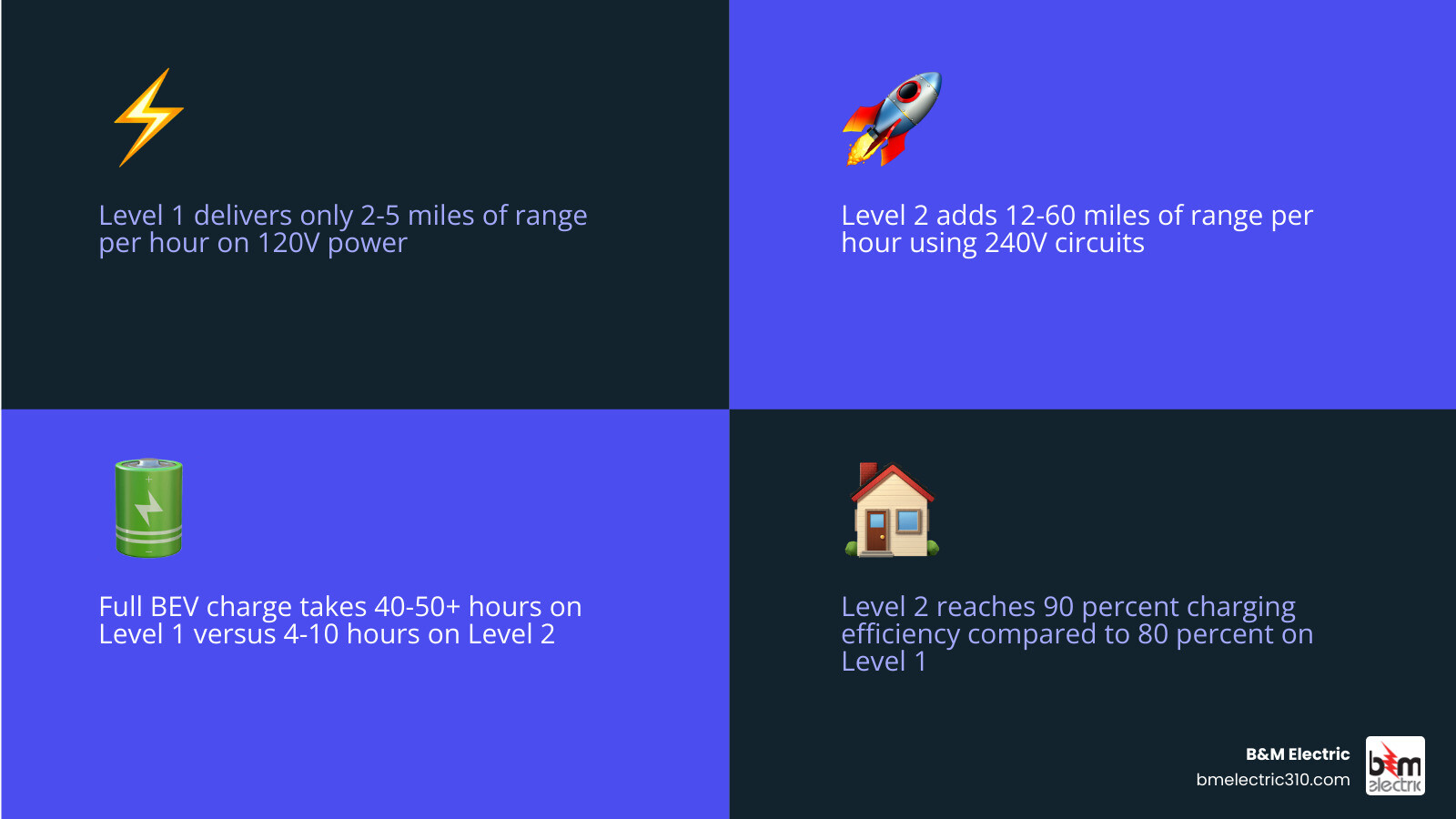
- Level 1 Speed: Adds approximately 2 to 5 miles of range per hour of charging.
- Level 2 Speed: Adds approximately 12 to 60 miles of range per hour of charging (depending on the charger’s amperage and the vehicle’s onboard charger limits).
But what about efficiency? Many drivers do not realize that charging an electric vehicle involves some energy loss. The power coming from your wall must be converted from AC to DC (direct current) by your car’s onboard charger. This conversion process generates heat, resulting in energy waste.
Level 1 chargers are only about 80% efficient. This means that for every 10 kWh of electricity you pull from your home’s electrical grid, only about 8 kWh actually makes it into your car’s battery pack. The other 20% is lost as heat.
Level 2 chargers, on the other hand, operate at roughly 90% efficiency. Because they deliver power at a higher voltage, the conversion process is faster and more efficient, wasting less energy. Over a year of daily driving, that 10% efficiency difference can add up to noticeable savings on your utility bill, helping you master maximizing efficiency charging your EV.
Furthermore, Level 1 chargers have a higher relative standby power draw. Because the car must remain “awake” for 40 hours to complete a charge, its internal cooling pumps, battery management systems, and computers run for a much longer period compared to a quick, efficient 5-hour Level 2 charge. You can learn more about how speed and smarter charging habits protect your pocketbook in our guide on how to save time money and sanity with home charging.
Charging Times for BEVs vs. PHEVs
The time it takes to charge your car depends heavily on the type of electric vehicle you own:
- Battery Electric Vehicles (BEVs): These run entirely on electricity and have large batteries. A typical BEV in 2026 has a battery capacity of 60 kWh to 100 kWh.
- Level 1: Charging a 75 kWh battery from empty to 100% would take over 50 hours.
- Level 2: The same battery can be fully replenished in 6 to 8 hours on a standard 40-amp Level 2 charger.
- Plug-in Hybrid Electric Vehicles (PHEVs): These combine a smaller electric battery with a gasoline engine. PHEV batteries usually range from 10 kWh to 20 kWh.
- Level 1: Because the battery is small, a standard 120V outlet can fully charge a PHEV in 5 to 10 hours (perfect for overnight charging).
- Level 2: A Level 2 charger can top off a PHEV in just 1 to 2 hours.
To save the most money while keeping your vehicle charged, we highly recommend setting your charger to run overnight when electricity rates drop. Our how EV charging during off-peak hours saves money A-Z guide breaks down how South Bay residents can take advantage of Time-of-Use (TOU) rates to charge their vehicles for a fraction of the standard daytime rate.
Home Installation Requirements and Electrical Considerations
A Level 1 charger requires zero installation—you simply open the trunk, pull out the cord that came with your car, and plug it into any standard wall outlet.
Level 2 chargers are a different story. Because they pull a significant amount of power, they require a dedicated 240V circuit installed by a professional electrician. You cannot simply use an extension cord or plug a Level 2 charger into a shared outlet.
When planning for a Level 2 charger, the first step is evaluating your home’s electrical panel:
- 100-Amp Panels: Many older homes in the South Bay have 100-amp or 125-amp electrical panels. If you have an electric oven, central AC, and a clothes dryer, your panel may not have enough leftover capacity to support a 40-amp or 50-amp EV charger. A professional load calculation is necessary to see if you can safely add the charger or if you need a panel upgrade.
- 200-Amp Panels: Modern homes usually feature 200-amp panels, which typically have plenty of room to accommodate a dedicated 240V circuit for an EV.
According to the National Electrical Code (NEC), an EV charger is considered a “continuous load.” This means the circuit breaker and wiring must be rated for 125% of the charger’s maximum output. For example, a charger drawing 40 amps of current requires a 50-amp circuit breaker and heavy-duty 6 AWG or 8 AWG copper wire to prevent overheating and fire hazards.
Before committing to an upgrade, it is incredibly helpful to review our cheat sheet to EV charger electrical requirements for home and learn about the essential home EV charging safety requirements that keep your property secure.
Garage vs. Outdoor Installation Challenges
Did you know that 56% of housing units in the United States either do not have a garage or do not park their vehicle inside of it? If you are parking in a driveway or an outdoor carport in Redondo Beach or Manhattan Beach, your installation requirements will look a bit different.
- NEMA Ratings: If your charger is going to be installed outside, it must have a weatherproof enclosure. Look for chargers rated NEMA 3R, NEMA 4, or NEMA 4X. These ratings ensure the unit is protected against rain, sleet, snow, and salt-heavy ocean breezes.
- Hardwired vs. Plug-In: For outdoor installations, we strongly recommend a hardwired connection rather than a plug-in unit (which plugs into a NEMA 14-50 outlet). Hardwiring eliminates the outlet entirely, creating a watertight seal that prevents moisture from entering the electrical connections. It also deters theft of the charging unit itself.
If you are planning an indoor setup, our guide on garage EV charger install covers the layout and cord management details you will want to keep in mind. For outdoor or complex driveways, check out these crucial car charger installation considerations.
Upgrading Your Home Electrical System
If your electrical panel is maxed out, you will need to upgrade your system to safely run a Level 2 charger. Upgrading your electrical panel not only prepares your home for an EV but also future-proofs your property for other electric upgrades like heat pumps or solar energy.
An electrical upgrade requires pulling local municipal permits and scheduling a post-installation inspection to ensure everything complies with building codes. This protects your home’s resale value and ensures your homeowner’s insurance policy remains valid.
To help you navigate these steps smoothly, we have mapped out the entire journey in our guides on how to understand the EV charger installation process and how to properly prepare electric vehicle charger installation at your home.
Frequently Asked Questions About EV Charging
Can I use a standard 120V outlet for daily EV charging?
Yes, you can absolutely use a standard 120V outlet for daily charging, but only if your daily driving habits allow for it. If you drive less than 30 to 35 miles per day and can leave your car plugged in for 10 to 12 hours every night, Level 1 charging can work.
However, it leaves you with zero margin for error. If you have an unexpected emergency or need to run errands over the weekend, you will quickly find yourself running out of battery. If you ever experience issues with your charging setup, you can learn how to diagnose them with our guide on troubleshooting EV chargers effectively.
Does Level 2 charging degrade the EV battery faster than Level 1?
No. There is a common myth that slower charging is always better for battery health, but modern EV batteries are highly sophisticated. Both Level 1 and Level 2 charging utilize alternating current (AC) and are considered “slow charging” methods by your car’s battery management system.
Battery degradation is primarily caused by extreme heat, which is common with ultra-fast Level 3 DC fast chargers, not residential Level 2 chargers. In fact, because Level 2 chargers are more efficient and allow the vehicle to complete its charge and go to sleep faster, they can actually reduce overall stress on your car’s electrical systems. To keep your system running optimally, read up on EV charger maintenance South Bay tips.
How do I prepare my home for a Level 2 charger installation?
Preparing your home starts with a clear plan. First, locate your main electrical panel and check its amperage rating (usually printed on the main breaker at the top of the panel). Next, decide where you want to mount the charger—ideally close to your car’s charge port so you do not have to stretch the cable.
Finally, reach out to a licensed electrician to perform a load calculation and run the dedicated 240V line. For a complete breakdown of what to look for in a charger and how to plan, check out our EV charger installation essentials guide.
Conclusion
In the level 1 vs level 2 EV charger comparison, the winner for most daily drivers is clear. While Level 1 charging is a convenient backup option for road trips or low-mileage plug-in hybrids, Level 2 charging is the gold standard that makes electric vehicle ownership seamless, stress-free, and highly efficient.
At B&M Electric, we bring over 50 years of local expertise to homes and businesses in Torrance, CA, and the surrounding South Bay communities. We specialize in providing dependable, precise electrical services with a warm, personal touch. Our licensed professionals handle everything from initial panel load calculations and municipal permitting to clean, code-compliant hardwired installations.
Ready to upgrade your home charging experience? We are here to help you every step of the way. Explore our comprehensive home EV charger install South Bay guide, or dive deep into local requirements with our Torrance EV charger installation guide and home EV charging setup in Torrance.
If you are looking for a trusted partner nearby, check out our resource on finding a certified EV charger installer near me Torrance, or go ahead and schedule your professional home EV charger installation with B&M Electric today!