The Homeowner’s Cheat Sheet for Title 24 Energy Compliance
By B&M Electric April 28, 2026
The Homeowner’s Cheat Sheet for Title 24 Energy Compliance
What California Homeowners Need to Know About Title 24 Energy Code Requirements
Title 24 energy code requirements for homeowners apply to most permitted construction projects in California — including new builds, additions, ADUs, HVAC upgrades, and even window replacements. Here’s a quick overview of what triggers compliance and what the 2025 standards expect:
Projects that typically require Title 24 compliance:
- New home construction
- Room additions and accessory dwelling units (ADUs)
- Major remodels affecting walls, windows, or mechanical systems
- HVAC replacements or alterations (when permitted)
- Window and door replacements (depending on scope)
- Garage conversions
Key 2025 Title 24 requirements for residential projects:
- Heat pumps are now prescriptively required for both space and water heating in new homes
- Wall insulation minimums increased (R-15 for 2×4 walls; R-21 for 2×6 walls)
- Solar PV systems are mandatory for most new low-rise residential buildings
- New homes with a 125-amp or larger service panel must be battery-storage ready
- All permanently installed lighting must be high-efficacy
- Specific rooms (bathrooms, garages, laundry rooms) require occupancy or vacancy sensors
If you’re planning any permitted work on your California home, Title 24 compliance isn’t optional — it’s a legal requirement before your project can receive final inspection approval and a certificate of occupancy.
Planning a home project in Torrance or the South Bay can feel overwhelming once energy codes enter the picture. California’s building energy standards are the most rigorous in the country, and the rules have grown more detailed with every three-year update cycle. The 2025 standards — effective January 1, 2026 — bring meaningful changes to how homes are built and upgraded, from stronger insulation requirements to a clear preference for heat pump technology.
The good news is that understanding these rules doesn’t require an engineering degree. Whether you’re adding a room, replacing your HVAC system, or building from scratch, knowing what Title 24 requires upfront can save you from costly permit delays, failed inspections, and last-minute redesigns. According to the California Energy Commission, these standards are projected to deliver $1.5 billion in consumer benefits and eliminate 10 million metric tons of greenhouse gas emissions over the next 30 years — meaning compliance isn’t just about passing inspection, it’s about building a more comfortable and cost-efficient home for the long run.
Understanding Title 24 Energy Code Requirements for Homeowners

When we talk about “Title 24,” we are specifically referring to Part 6 of the California Building Standards Code. Managed by the California Energy Commission (CEC), these standards ensure that all new and altered buildings in our state use energy efficiently. Since its inception in 1978, Title 24 has saved Californians billions of dollars in reduced electricity bills.
As we move through April 2026, we are currently operating under the 2025 Standards (which became effective January 1, 2026). This cycle is a major step toward California’s goal of complete decarbonization and a net-zero energy future. For us as homeowners in the South Bay, this means our projects must align with specific “energy budgets.”
One thing to keep in mind is that California is divided into 16 climate zones. Torrance and the surrounding coastal areas typically fall into Climate Zone 6, which has different requirements than the hotter inland zones. This is why a “one-size-fits-all” approach to energy compliance doesn’t work. If you find that your home has old, non-compliant wiring or systems during a renovation, you may need an Electrical Code Violation Repair to ensure your home is safe and ready for high-efficiency upgrades.
Which Home Projects Trigger Title 24 Compliance?
A common misconception is that Title 24 only applies to brand-new mansions. In reality, almost any project that requires a building permit will trigger some level of energy code review. This includes:
- New Construction: Every new house, including Accessory Dwelling Units (ADUs) or “granny flats.”
- Additions: Adding a new bedroom, expanding a kitchen, or converting a garage into living space.
- Alterations: Major remodels where you are stripping walls down to the studs or changing the “envelope” of the house.
- Mechanical Changes: Replacing an entire HVAC system or water heater.
- Fenestration: Replacing a significant number of windows or doors.
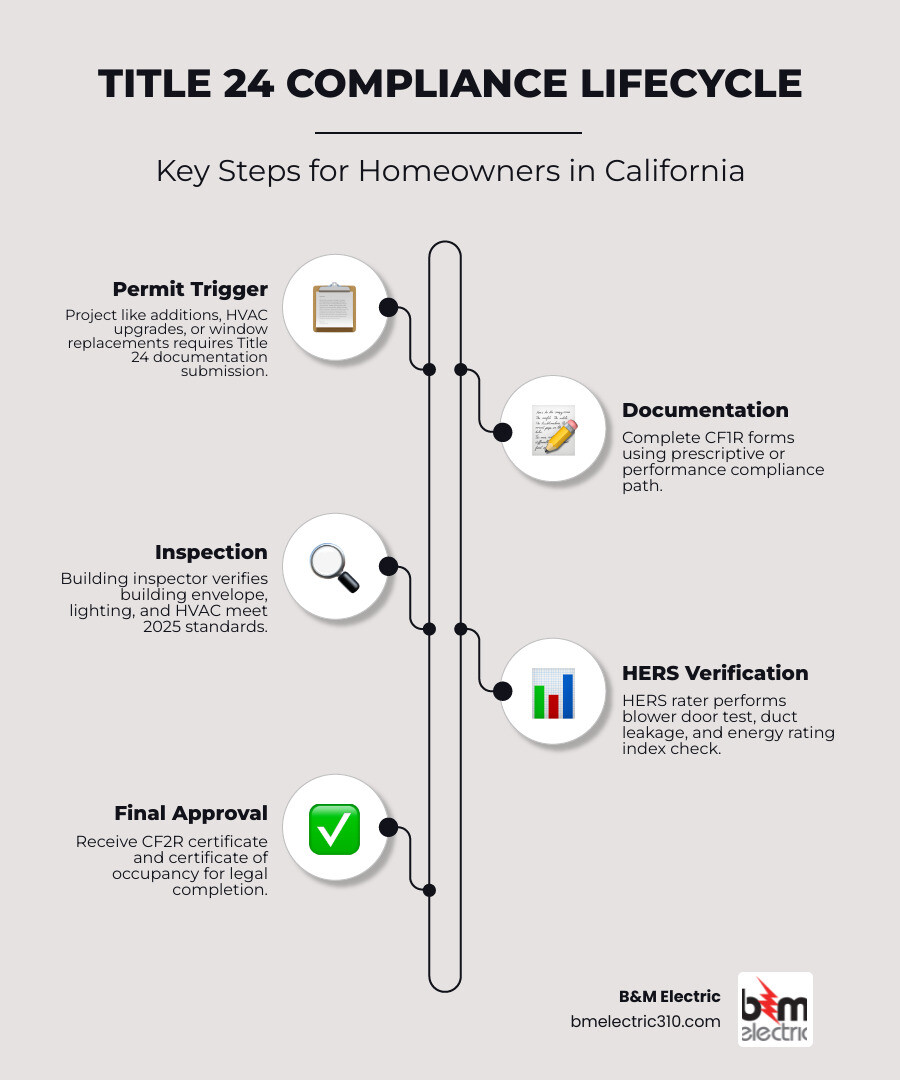
The enforcement happens at the local building department. When you submit your plans for a permit, the city will look for your Title 24 documentation (usually the CF1R form). Without it, your permit won’t be issued. This is why the Importance of Electrical Inspections cannot be overstated; catching compliance issues early prevents your project from stalling at the city desk.
Title 24 Energy Code Requirements for Homeowners: The Building Envelope
The “building envelope” is the barrier between your conditioned indoor air and the outdoor environment. Title 24 is very strict about how this barrier performs.
- Insulation R-values: The “R-value” measures how well insulation resists heat flow. In the 2025 cycle, mandatory wall insulation has increased. For standard 2×4 wood-framed walls, you now need R-15 insulation. For 2×6 walls, it’s R-21. Cathedral ceilings (ceilings without an attic space) now require a minimum of R-38 across all climate zones.
- Windows (Fenestration): Windows are often the weakest point in an energy envelope. Title 24 looks at two numbers: the U-factor (how much heat escapes) and the Solar Heat Gain Coefficient (SHGC) (how much solar heat enters). The 2025 code has reduced the allowable U-factor for many projects, meaning you’ll likely need high-performance double-pane or low-E glass.
- Cool Roofs: To combat the “urban heat island” effect, many roofing projects in California now require “cool roof” materials. These are shingles or tiles that reflect sunlight and emit heat rather than absorbing it into your attic. Achieving these Green Energy Savings not only helps the planet but keeps your South Bay home much cooler during those September heatwaves.
Title 24 Energy Code Requirements for Homeowners: Lighting and Controls
Lighting standards in California have changed drastically. We no longer just look at the bulb; we look at the “luminaire” (the whole fixture) and how it’s controlled.
- High Efficacy Only: All permanently installed lighting in your home must be “high efficacy.” This generally means LED lighting. Specifically, bulbs and fixtures should be JA8-compliant, which ensures they meet California’s standards for color quality, dimming, and longevity.
- Mandatory Controls: You can’t just have a simple on/off switch anymore for certain rooms. Bathrooms, garages, laundry rooms, and utility rooms must have at least one fixture controlled by an occupancy or vacancy sensor that turns the light off automatically when the room is empty.
- Dimming: Most JA8-compliant lights in living areas (kitchens, bedrooms, dining rooms) must be equipped with dimming controls to help you manage energy use.
- Outdoor Lighting: Exterior lights must be controlled by a combination of a photocontrol (dusk-to-dawn) and either a motion sensor or an astronomical time clock.
Switching to these modern systems is one of the easiest ways to see Lower Energy Bills with LED Lighting while staying fully compliant with the latest state mandates.
Mandatory 2025 Standards for HVAC and Water Heating
The 2025 Title 24 update represents a massive shift toward electrification. The state has moved to a “single-fuel baseline,” which effectively makes heat pumps the standard for both space heating and water heating in new construction.
- Heat Pump Requirements: While gas appliances are not “banned” statewide, the energy budget for a new home is calculated as if you are using a heat pump. If you choose gas, you have to “make up” for that energy loss by adding extra insulation or better windows elsewhere.
- Electric-Ready Provisions: Even if you install a gas stove or water heater today, the 2025 code requires new homes to be “electric-ready.” This means the builder must install the necessary electrical conduit and panel capacity so a future homeowner can easily switch to electric appliances without a massive rewiring job.
- Battery-Ready: If your new home has a 125-amp service panel (which is standard for most modern South Bay homes), it must be “battery-storage ready.” This includes leaving space in the panel and designated areas for a future home battery system.
- Duct Leakage Testing: For any new HVAC installation or major alteration, a third-party tester must verify that your ducts aren’t leaking more than 4% of the air they carry.
These requirements are designed to work together, and we often provide Energy Saving Services by Electricians to help homeowners upgrade their panels and circuits to support these high-efficiency heat pump systems.
The Compliance Process: From Permits to HERS Verification
Navigating the paperwork for Title 24 can be the most confusing part of a remodel. There are two main ways to prove your home is compliant:
| Feature | Prescriptive Path | Performance Path |
|---|---|---|
| Flexibility | None. You must follow a rigid checklist. | High. You can trade off features. |
| Complexity | Simple, but often more expensive to build. | Requires complex energy modeling software. |
| Best For | Simple window swaps or small additions. | New homes, ADUs, and large remodels. |
| Example | Every window must have a U-factor of 0.30. | You use “okay” windows but “amazing” insulation. |
Once your path is chosen, you’ll encounter the “CF” forms:
- CF1R: The compliance report submitted with your permit application.
- CF2R: The installation certificate signed by your contractor (like us!) confirming the equipment was installed as planned.
- CF3R: The verification report signed by a HERS Rater.
A HERS (Home Energy Rating System) Rater is a certified third party who comes to your home to perform specialized tests, such as a blower door test (to check for air leaks in the house) or a duct leakage test. They are the “referees” of the energy code. Ensuring your project is ready for these tests is vital, as Electrical Inspections Prevent Issues that could lead to a failed HERS report and a delayed certificate of occupancy.
Frequently Asked Questions about Title 24
Do I need Title 24 documentation for a simple window replacement?
In many cases, yes. If you are replacing a significant number of windows, the city will require a Title 24 report to prove the new windows meet the current U-factor and SHGC requirements for our climate zone. Even a small mismatch between what you buy and what the code requires can cause an inspection failure.
Is a HERS rater mandatory for all residential projects?
Not all, but most projects involving HVAC systems, new insulation, or whole-house air sealing will require HERS verification. If you are just changing light fixtures or doing a minor kitchen remodel that doesn’t move walls, you likely won’t need one. However, for additions and new builds, a HERS rater is almost always part of the process.
Does the 2025 code cycle ban gas appliances in California?
No, there is no statewide ban on gas stoves or furnaces in existing homes. However, the 2025 code makes it much more difficult (and often more expensive) to install gas in new construction because the energy “penalty” for gas is so high. Some local cities in the South Bay may have even stricter “reach codes” that go beyond the state minimums, so always check with your local building department.
Conclusion
Navigating title 24 energy code requirements for homeowners doesn’t have to be a headache. While the 2025 standards are the most advanced yet, they are designed to create homes that are more comfortable, quieter, and significantly cheaper to operate. By focusing on high-performance insulation, smart lighting controls, and the shift toward heat pump technology, you are future-proofing your most valuable investment.
At B&M Electric, we’ve spent 50 years serving Torrance and the South Bay communities. We understand the local climate zones and the specific quirks of the building departments in our area. Whether you need to Discover LED Lighting Solutions that meet JA8 standards or you need a panel upgrade to make your home “electric-ready,” we bring precision and care to every project.
Don’t let energy code confusion stall your dream remodel. Contact a Professional Electrician at B&M Electric today, and let us help you power your home’s future with confidence and local expertise.