The Homeowner’s Guide to Staying Current with Electrical Code Changes
By B&M Electric April 23, 2026
The Homeowner’s Guide to Staying Current with Electrical Code Changes
Why California Electrical Codes Homeowners Should Know Matter More Than Ever
The california electrical codes homeowners should know cover a lot of ground — from which outlets need GFCI protection to when you need a permit for a simple circuit upgrade. Here’s a quick overview of the most important ones:
- GFCI protection is required in kitchens, bathrooms, garages, laundry areas, crawl spaces, and all outdoor outlets
- AFCI protection is required on all 120-volt, 15- and 20-amp branch circuits in living areas, bedrooms, hallways, and kitchens
- Tamper-resistant receptacles (TRRs) are mandatory in all new construction and remodels
- Dedicated circuits are required for refrigerators, dishwashers, microwaves, and laundry appliances
- Permits are required for new circuits, panel upgrades, outlet additions, and most electrical modifications
- A licensed C-10 electrician must perform most permitted residential electrical work in California
- Local amendments — like LA County’s Title 27 — may add requirements on top of state code
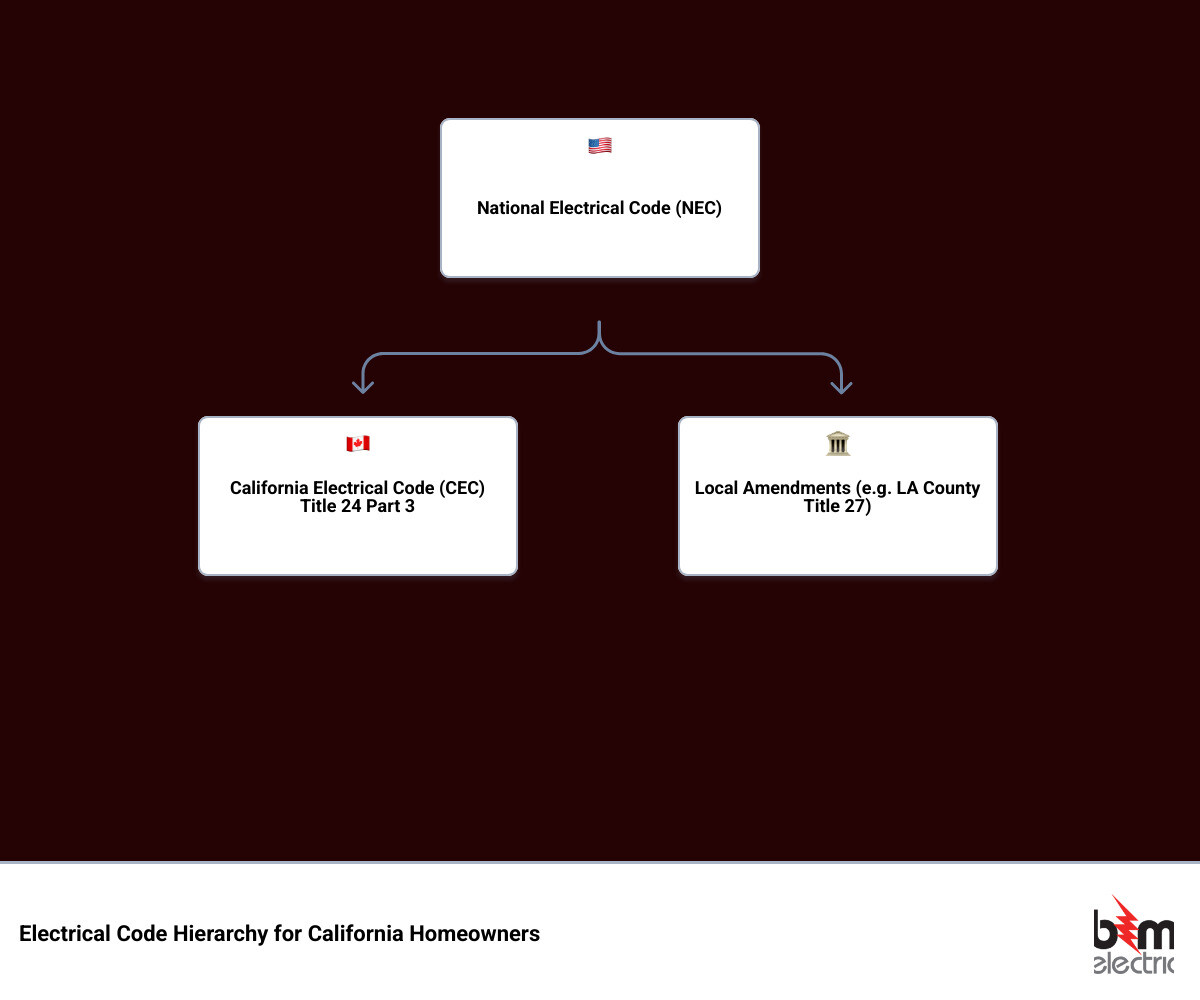
California follows the National Electrical Code (NEC) as its foundation, but the state layers on its own amendments through the California Electrical Code (CEC), which is Part 3 of Title 24. The most recent edition — the 2025 CEC — took effect January 1, 2026. That means homeowners planning any remodel, addition, or upgrade right now need to meet updated standards they may not have heard of yet.
And the stakes are real. Over 31,000 home electrical fires occur in the US every year, and many are tied to installations that didn’t meet code. In earthquake-prone areas like the South Bay, the risks are compounded by seismic safety requirements that California adds on top of the national baseline.
Whether you’re renovating a kitchen, adding an EV charger, or just replacing an outlet, knowing where the rules apply — and when you need a professional — can save you from costly surprises during inspection or at the point of sale.
Understanding the 2025 California Electrical Code (CEC)

As of April 2026, we are officially operating under the 2025 Triennial Edition of the California Building Standards Code. Specifically, Title 24, Part 3 is where you’ll find the California Electrical Code (CEC). While the state updates these codes every three years, the 2025 edition became effective on January 1, 2026.
This code isn’t just a set of suggestions; it is the law for every home in Torrance and the surrounding South Bay. The CEC uses the National Electrical Code (NFPA 70) as its “base,” but it adds specific layers of safety and energy efficiency that are unique to the Golden State. If you are planning a project, a professional Electrical Code Audit Torrance is the best way to ensure your existing system won’t fail a modern inspection.
Key California amendments homeowners should know
California is famous for its strict regulations, and the electrical code is no exception. Some of the most critical amendments involve:
- Seismic Safety: Unlike many other states, California requires electrical equipment to be securely braced. This means your main service panel and heavy transformers must be mounted to withstand the shaking of an earthquake.
- Grounding and Bonding: The 2025 code places heavy emphasis on ensuring your home’s electrical system is properly bonded to the cold water pipe and a grounding electrode (ground rod) to prevent shock during a fault.
- Title 24 Energy Efficiency: This dictates everything from the type of light bulbs you use to the requirement for occupancy sensors in certain rooms.
If you’ve discovered that your home has unpermitted work or outdated wiring, you may need an Electrical Code Violation Repair to bring things up to current 2026 standards.
Differences between the NEC and CEC
While the NEC is used across the country, California “tweaks” it to address our unique environment. For example, the CEC has more aggressive requirements for Energy Storage Systems (ESS), such as home batteries. California also leads the way in wildfire mitigation, requiring specific “hardening” of electrical systems in high-risk zones. While homeowners primarily focus on residential rules, understanding Commercial Electrical Code Compliance can be helpful for those who own mixed-use properties or home-based businesses that require heavy power loads.
Room-by-Room California Electrical Codes Homeowners Should Know
When we walk through a home in Redondo Beach or Manhattan Beach, we look at the electrical system room by room. The california electrical codes homeowners should know vary depending on whether you are in a “wet” area like a bathroom or a “dry” area like a bedroom. Ensuring these are correct is a major part of Electrical Inspections Safeguarding Home.
Kitchen and bathroom circuit requirements
Kitchens and bathrooms are the most “code-heavy” rooms in your house because water and electricity are a dangerous mix.
- Kitchen Island Rule: If your island or peninsula is larger than 24″ x 12″, it requires at least one outlet. This catches many homeowners off guard during a remodel!
- Dedicated 20-Amp Circuits: You must have at least two “small appliance” circuits in the kitchen. Major appliances like dishwashers, refrigerators, and microwaves usually require their own dedicated circuits to prevent the breaker from tripping every time you make toast.
- GFCI & AFCI Overlap: In 2026, kitchen countertop outlets must have both Ground-Fault (for shock) and Arc-Fault (for fire) protection.
- Bathrooms: You need at least one outlet within 3 feet of the sink, and it must be on a dedicated 20-amp circuit that doesn’t power lights or outlets in other rooms.
For a deeper dive into what local inspectors look for, check out our Electrical Inspections Torrance Ca Guide.
Living areas and hallway california electrical codes homeowners should know
In living rooms, bedrooms, and hallways, the goal is to prevent the use of dangerous extension cords.
- The 6-Foot/12-Foot Rule: No point along a floor line in a habitable room can be more than 6 feet from an outlet. This means outlets are typically spaced every 12 feet.
- Wall Space: Any wall segment 2 feet or wider requires an outlet.
- Hallways: If a hallway is 10 feet or longer, it must have at least one receptacle.
- Tamper-Resistant Receptacles (TRRs): These are now mandatory everywhere. They have internal shutters that prevent children from sticking objects into the slots.
If you are buying or selling a home in the area, a reputable Electrical Inspections Company In Redondo Beach Ca can verify these spacings for you.
Permits, Inspections, and Local Amendments
Many homeowners ask us, “Do I really need a permit for this?” In California, the answer is almost always yes. Whether you live in unincorporated LA County or a city like Torrance, Title 27 of the LA County Code (which adopts the CEC) mandates permits for almost all electrical work.
Navigating HOA and local california electrical codes homeowners should know
If you live in an HOA, you have an extra layer of rules. However, California state laws often protect your rights:
- Solar Rights Act: Your HOA generally cannot stop you from installing solar panels.
- Right to Charge Law: HOAs cannot unreasonably block the installation of an EV charger in your designated parking space.
- Davis-Stirling Act: This governs how HOAs can enforce rules. Even so, you must usually submit an architectural review application before starting electrical work that affects the exterior.
Skipping permits or HOA approval can lead to heavy fines, legal “stop-work” orders, and issues when you try to sell your home.
Preparing for a successful electrical inspection
The inspection process usually happens in two stages. First is the rough-in inspection, where the inspector looks at the wires and boxes before the drywall goes up. Second is the final inspection, where they test the outlets and breakers.
To pass, you must ensure:
- Clearance: There must be a 30-inch wide by 36-inch deep clear space in front of your electrical panel. No storing boxes or water heaters in the way!
- Labeling: Your circuit breaker panel must be clearly and accurately labeled.
- Licensed Work: Inspectors may ask for proof that a C-10 licensed contractor performed the work.
We cannot overstate the Importance Of Electrical Inspections for your family’s safety.
Future-Proofing: EV Chargers, Solar, and Energy Standards
The 2025/2026 codes are heavily focused on California’s green energy goals. New homes and major remodels are now required to be “EV Ready.” This means even if you don’t own an electric car yet, you may need to install the conduit or panel capacity for a 240-volt charger now.
| Protection Type | Primary Purpose | Required Locations (2026) |
|---|---|---|
| GFCI | Prevents Electrocution | Bathrooms, Kitchens, Garages, Outdoors, Sinks |
| AFCI | Prevents Electrical Fires | Bedrooms, Living Rooms, Hallways, Kitchens |
| TRR | Child Safety (Shock) | All Habitable Areas of the Home |
Seismic safety and electrical hardening
In the South Bay, we live near major fault lines. The CEC requires that electrical boxes be securely mounted to the structure. Flexible metal conduit (BX) is often used in specific areas to allow for slight movement without snapping wires. Additionally, if you live in a Wildland-Urban Interface (WUI) zone, you may need “hardened” exterior fixtures that resist embers and heat.
Title 24 and energy efficiency mandates
Title 24, Part 6 is the “Energy Code.” For homeowners, this means:
- High-Efficacy Lighting: Almost all permanently installed fixtures must be LED.
- Controls: Bathrooms, garages, and laundry rooms often require occupancy sensors (lights that turn off automatically).
- Dimmers: Most other rooms require dimmer switches to reduce energy consumption.
Frequently Asked Questions about California Electrical Codes
Can a homeowner perform their own electrical work in California?
Technically, yes, under the “Owner-Builder” exemption, but only if you live in the home and it is a single-family dwelling. However, you are still legally required to pull the same permits and pass the same inspections as a pro. Because of the complexity of the california electrical codes homeowners should know, most people find that hiring a licensed C-10 electrician is much safer and actually faster.
What are the most common electrical code violations in California?
We frequently see these five issues:
- Improper Grounding: Especially in older South Bay homes.
- Overlamping: Putting a 100-watt bulb in a fixture rated for 60 watts.
- Lack of TRRs: Using old-style outlets during a remodel.
- Panel Clearance: Blocking the electrical panel with shelving or appliances.
- Unpermitted Circuits: Adding an outlet in a garage or patio without a permit.
Where are GFCI and AFCI breakers required in 2026?
GFCI is required anywhere moisture is present (kitchens, baths, outdoors, garages). AFCI is required in almost every “habitable” room (bedrooms, family rooms, dining rooms) to detect dangerous sparking. In many modern kitchens, you actually need “Dual Function” breakers that provide both types of protection.
Conclusion
Staying compliant with the california electrical codes homeowners should know isn’t just about following the law — it’s about protecting your home and your family. With over 50 years of local expertise right here in Torrance, we’ve seen the codes evolve from simple wiring to the complex, high-tech systems required in 2026.
At B&M Electric, we pride ourselves on providing dependable service with a personal touch. Whether you need a simple safety check or a full panel upgrade to support your new EV charger, we bring precision and care to every job. Don’t leave your safety to chance or outdated DIY work.
Schedule a professional inspection with a licensed South Bay electrician today and ensure your home is powered safely for years to come.